
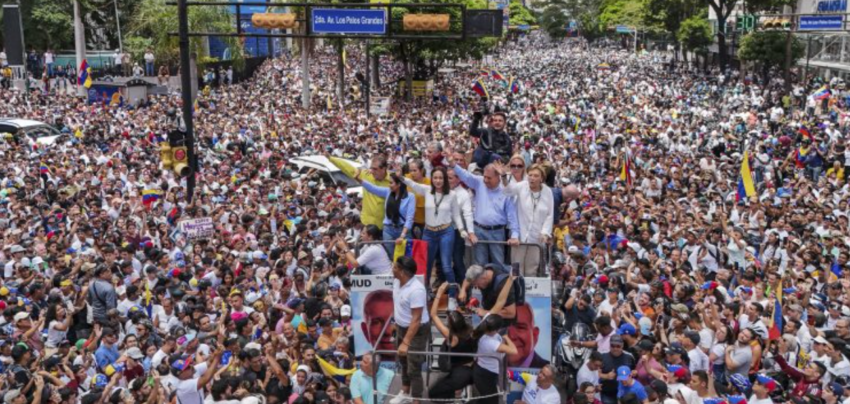
After a highly contentious campaign cycle and strong polling for the opposition, Venezuelan election officials declared President Nicolás Maduro the winner of Sunday’s presidential election, sparking major controversy.
Publicado en The Soufan Center, el 2 de agosto de 2024
- Violent clashes have left at least 16 people dead and 750 arrested after thousands demonstrated against the election results reported by Venezuelan authorities, with further protests and counterprotests expected in the coming days.
- Many countries, including the U.S., have expressed doubts over the legitimacy of the election results, and the lack of transparency and accusations of repression will likely impact regional relations and potentially lead the U.S. to reconsider easing economic sanctions.
- Maduro remaining in power could lead to an increase in Venezuelans leaving the country, impacting regional stability and possibly leading to an increase of asylum seekers at the U.S. southern border in the wake of the upcoming U.S. presidential election.
After a highly contentious campaign cycle, Venezuelan election officials declared President Nicolás Maduro the winner of Sunday’s presidential election, despite pre-election polling showing the opposition with overwhelming support. Although election authorities – who many believe are loyal to Maduro – stated that the current president defeated opposition figure Edmundo González with 51 percent of votes, the government has not released the full results for verification. The decision to declare Maduro the victor, without releasing detailed voting results as it has typically done, heightened disillusionment among many Venezuelans and election observers that the result was fraudulent.
Prior to the election, independent polls showed the opposition with overwhelming support, with upwards of 72 percent of voters stating they would vote for González. Support for Maduro ranged from 12 to 25 percent depending on the poll. The opposition has refuted the results presented by the authorities, releasing updated results from 81 percent of the nation’s voting machines demonstrating that González had won 7.1 million votes – 67 percent of the vote share – to Maduro’s 3.2 million – 30 percent of the overall vote share. González called the margin “mathematically irreversible.”
Under Maduro, mass migration, government repression, and an economic crisis have fueled support for the opposition, particularly leader María Corina Machado who was barred from running in the election by Venezuela’s highest court. Analysts agree that she posed the biggest electoral threat to Maduro in years. After her chosen successor was also barred from running, she threw her weight fully behind González – whom many credit for his popularity in the polls. 91.8 percent of González voters said they backed him because he is backed by Machado, according to the Caracas-based pollster Meganálisis. The momentum of the opposition fueled hope among many Venezuelans that Maduro could finally be electorally ousted from power, after years of what many describe as autocratic rule.
Thousands of protesters took to the streets of Caracas, the nation’s capital, to denounce the election result. Both pro-government and opposition figures called on followers to take to the streets, resulting in violent clashes and at least 16 people dead, according to the Venezuelan-based human rights organization Foro Penal and hospital reports. 750 people have also been arrested, with the government warning that some would be charged with “terrorism.”
Reports have circulated of unknown assailants firing on protestors and armed motorcyclists firing into crowds. Maduro’s government has been known to use armed bands of men on motorbikes, also known as colectivos, to crackdown on protests and crush any dissent to his rule. The colectivos began as far-left pro-government community organizations but are essentially considered a paramilitary group armed by the government, according to many scholars and the UN Human Rights Commission. Members have been known to carry out extrajudicial killings, kidnapping, and extortion, in addition to controlling lucrative food distribution networks and drug trafficking.
Further, a video appeared online allegedly showing a Wagner mercenary working on the side of Maduro’s enforcers during the protests. Locals have reported that the private military company has been in Venezuela for years to provide security for Maduro and militia training. Despite the violence, widespread frustration over the official results and calls from across the political spectrum to take to the streets will likely result in further protests and counterprotests in the coming days.
Maduro’s government announced it would investigate top opposition figures, accusing them of hacking into electoral computer systems, and National Assembly President Jorge Rodriguez, a Maduro ally, called for Machado and González to be arrested. In the lead up to the election, several people connected to the opposition’s campaign were detained, and a key opposition figure – Freddy Superlano, the national political coordinator – was arrested on Tuesday, according to his party Voluntad Popular.
The opposition has called on the international community to condemn the “escalation of repression,” claiming that the government has intensified its targeting of activists demanding transparency and the publication of results from polling stations. Rather than an aberration, Venezuelan elections under Maduro have often been marked by government interference, suppression of the opposition, and political violence. 200 independent activists are in prison, according to Chatham House, and Juan Guaído, the former opposition leader and interim president, fled to the U.S. in April 2023, months before an arrest warrant was issued for him for the alleged crimes of treason, money laundering, among others.
Several countries in the region and beyond, including Argentina, Chile, and the U.S., among others, have expressed doubts that the election result reported by authorities was legitimate, and that the election was marked by widespread irregularities. Other countries, including Cuba, Nicaragua, Iran, and Russia, congratulated Maduro on his reelection, with some, such as Mexico’s President Andres Manuel Lopez Obrador stating that there was no evidence of fraud.
Seven Latin American countries’ diplomatic missions were expelled by the Venezuelan government due to their expressed doubts over the election, signaling that the outcome is likely to impact regional relations. The election will potentially exacerbate tensions over the border dispute with Guyana, with many in the neighboring, oil-rich country fearing that political and military tensions in the region will continue to rise with Maduro still in power. Moreover, as Maduro’s commitment to a free and fair election in 2024 was the pre-condition for easing economic sanctions, the U.S. may reconsider its policy.
Maduro remaining in power and the heightened political instability in Venezuela could lead to a renewed increase of people leaving the country, further impacting regional stability. Colombia hosts the highest population of Venezuelan migrants and refugees, over 2.8 million people as of January 2024, according to the International Organization for Migration (IOM). The sharp increase of Venezuelans entering Colombia since 2015 has led to a cultural and xenophobic backlash against migrants and refugees, with Venezuelans in the country often blamed for crime and other social problems – particularly by government officials and politicians. Further, a potential outflux of Venezuelans leaving the country could lead to an increase in asylum seekers at the U.S. southern border, an increasingly common destination for Venezuelan refugees and migrants in recent years. Such a scenario is likely to impact the upcoming U.S. presidential election in November, where immigration issues have again become a fixture of the political debate and tensions.