
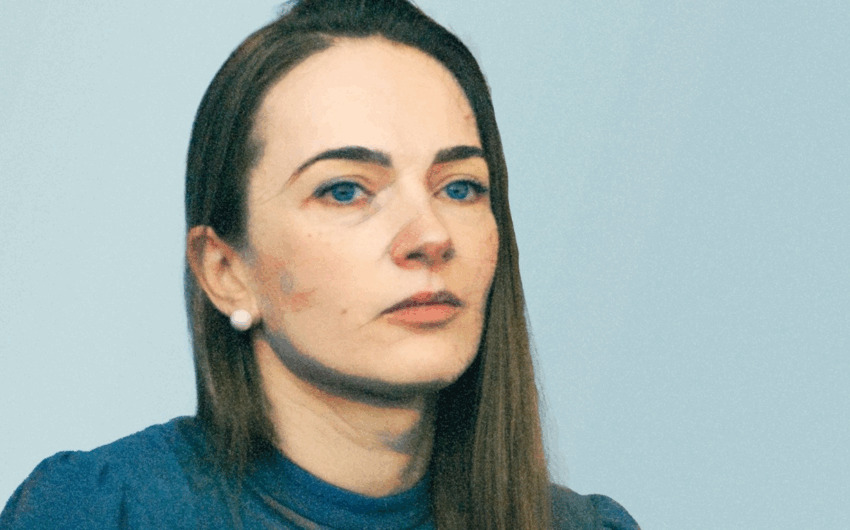
Last week, the Council of Europe announced the formation of a new criminal tribunal to prosecute the crime of aggresson by Russia against Ukraine. Oleksandra Matviichuk, Nobel Peace Prize laureate, and her team have tracked Russian war crimes for years.
Publicado en The European Correspondent, el 14 de mayo. Por Klara Vlahcevic Lisinski
By the time Oleksandra Matviichuk walked on stage to receive the Nobel Peace Prize in 2022, she had already spent years documenting horrors too immense to ignore. Today, as the head of the Centre for Civil Liberties (CCL) in Kyiv, she is helping lead an effort many deem historic: the creation of a special tribunal to prosecute Russian leaders – starting with Vladimir Putin – for the crime of aggression.
And now, her mission had one major success: last week, a new tribunal for Russian war criminals responsible for the invasion of Ukraine was formed. Talking to The European Correspondent, Matviichuk explained how the newly launched Tribunal for Putin seeks to close one of international justice’s most glaring gaps.
«The official announcement by about 40 foreign ministers is just the first step,» she says. «We expect the formal agreement with the Council (of Europe) to be signed this month. But a structure must still be created. Judges and prosecutors need to be appointed. The real work begins now.»
Since the beginning of the full-scale invasion, Matvichuuk’s team has documented more than 86,000 war crimes, she says. «These crimes were only possible because Putin and his top political and military officials decided to invade.»
Her organisation has joined forces with dozens of regional partners to create a national network of documenters. «We’ve faced an unprecedented number of war crimes,» she says. «We have an ambitious goal – to document every single criminal episode that has been committed in the smallest settlement of every oblast in the country.»
This vast civilian-led network operates even in occupied areas, gathering testimony and digital evidence not only for legal trials but to preserve memory itself. «We are documenting more than violations of the Geneva or Hague Conventions,» Matviichuk says. «We are documenting human pain.»
While the International Criminal Court (ICC) has issued arrest warrants for Putin and one top aide related to the deportation of Ukrainian children, it hasn’t opened one on the crime of aggression. The Tribunal for Putin, set up under the umbrella of the Council of Europe – separate and complementary to the ICC – aims to fill that gap. Its creation, Matviichuk argues, is not just a response to this war, but a precedent-setting act for global justice.
«If we want to prevent wars in the future, we must punish the leaders who start them now,» she insists. «In the entire history of humankind, there has only been one precedent for prosecuting the crime of aggression: Nuremberg. And that only came after the Nazi regime collapsed. We are living in the 21st century. Justice should not depend on how or when a war ends.»
Does this mean Putin will be in jail soon? Most likely not. But Matviichuk argues momentum must be sustained as headlines shift elsewhere. «This war has not only a military dimension – it has an informational one,» she warns. «If Russia committed atrocities in Bucha when the world was watching, what hell awaits us if we lose that attention?»
Ultimately, the Tribunal for Putin is about more than legal mechanisms or geopolitics. It is, for Matviichuk, about dignity, accountability, and moral clarity. «This is not only a Ukrainian war,» she says. «It is a war for the rules-based international order. And it’s time we start enforcing those rules – starting at the top.»