
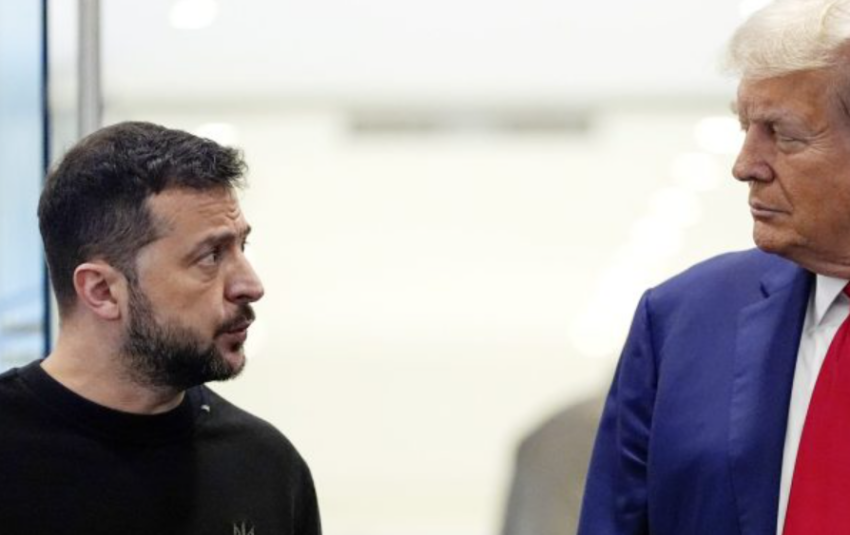
U.S. President Donald Trump and Ukrainian President Volodymyr Zelensky were set to sign a landmark bilateral agreement on Ukraine’s natural resource supplies, particularly its critical minerals reserves, but the deal collapsed last week during a meeting at the White House that went off the rails.
Publicado en The Soufan Center, el 5 de marzo de 2025
- The expectation that the minerals deal would help secure ongoing U.S. military aid to Ukraine was upended on Monday when the U.S. announced it would temporarily suspend its delivery of military aid to Ukraine, pending further review.
- Trump’s fascination with stockpiling critical minerals is not unique to Ukraine; he has expressed his interest in extracting minerals from Greenland, Canada, and even Russia.
- As critical minerals have played an increasingly important role in U.S. foreign policy, it is not the mining of the resources that threaten the supply chain, but rather the processing and refining.
U.S. President Donald Trump and Ukrainian President Volodymyr Zelensky were set to sign a landmark bilateral agreement related to Ukraine’s natural resource supplies, particularly Kyiv’s critical minerals reserves, but the deal collapsed last week during a shocking televised meeting at the White House. Since then, both leaders have expressed a willingness to move forward, with Zelensky reiterating his desire to sign the agreement and Trump stating that he believes the deal can still be revived. Zelensky also emphasized Ukraine’s continued reliance on U.S. support, declaring that his country and its military “count on assistance from the United States without a doubt.” However, the expectation that the minerals deal would help secure ongoing U.S. military aid to Ukraine was upended on Monday when the U.S. announced it would temporarily suspend its delivery of military aid to Ukraine pending further review. Without continued U.S. support to Ukraine’s military, it is likely that Moscow would be able to break the current stalemate, allowing Russia to occupy even more territory, killing more Ukrainian civilians in the process.
Initially, Ukrainian leaders offered little response following Monday’s announcement that the U.S. would pause military aid to Ukraine. However, early yesterday morning, Ukrainian officials attempted to quell growing international concern, asserting that Ukrainian forces could maintain the frontline despite the aid suspension, with Prime Minister Denys Shmyhal stating that they had the necessary capabilities and tools to «maintain the situation on the front line.» A number of military analysts have cast doubt upon this assertion. Shmyhal also emphasized Ukraine’s commitment to continued cooperation with the U.S., despite the decision, which has been a huge blow to Ukrainian morale. A few hours later, President Volodymyr Zelensky released a statement on the social media platform X, reaffirming Ukraine’s willingness to work with the U.S. toward a lasting peace, emphasizing his interest in the UK-France-Ukraine conceptualized ceasefire plan that includes “the release of prisoners and truce in the sky” with Russia. He also expressed regret over the explosive White House press conference over the weekend and reiterated his commitment to finalizing the critical minerals deal with the U.S.
While the Trump administration viewed the minerals deal as a mutually beneficial agreement that also served as a de facto security guarantee for Ukraine, President Zelensky had previously insisted that an explicit security assurance from the U.S. was necessary, arguing that economic agreements alone were not enough to ensure the country’s long-term security. However, in his statement on Tuesday, the Ukrainian president asserted that they were “ready to sign [the deal] in any time and in any convenient format,” describing it as “a step toward greater security and solid security guarantees,” leaving his previous insistence on an explicit security guarantee somewhat ambiguous.
Should the critical minerals deal be signed, as the framework currently stands, it would establish a jointly owned fund in which Ukraine would contribute “half of its revenues from the future monetization of natural resources and associated infrastructure,” according to the New York Times. This includes revenues from oil, natural gas, and most notably, mineral deposits. However, this does not include the existing operations contributing to Ukraine’s revenue – such as Naftogaz and Ukrnafta, Ukraine’s largest oil and gas producers – meaning that the revenue collected under the agreement would have to be made up from entirely new ventures with some of the revenue then being reinvested into Ukraine.
Trump’s fixation with stockpiling critical minerals is not unique to Ukraine. He has expressed his interest in extracting minerals from Greenland, Canada, and even Russia; however, should the deal be signed, Trump is hedging a big bet that the supply of Ukraine’s reserves will yield a strategic return in the short or medium term. “From the time reserves have been identified, globally, it takes an average of 18 years to develop a mine and costs $500 million and $1 billion to build a mine and separation plant,” according to the Center for Strategic & International Studies. Additionally, it is unclear what minerals and how much of them Ukraine even has on its territory. The last geological survey was done 30-60 years ago by the Soviet Union using outdated testing methods. Without this information, it is unlikely to attract the necessary investment. Furthermore, much of Ukraine’s infrastructure has been decimated as a result of the Russian invasion, especially as Moscow has targeted much of Ukraine’s critical infrastructure, slicing Ukraine’s power generation capacity to about a third of its prewar capacity. Without sufficient energy, these projects will be unable to operate.
As critical minerals have played an increasingly important role in U.S. foreign policy, and will be even more important in the future, it is not the mining of the resources that threaten the supply chain, but rather the processing and refining. The Trump administration has emphasized these critical minerals as essential to national security as they are used in a variety of military equipment as well as in commercial items such as cell phones.
However, raw minerals are useless until they have been processed. Therefore, the U.S. could acquire as many of these minerals as it wants, whether from Ukraine, Greenland, or Canada, but the minerals need to be refined, a method currently monopolized by China. The Biden and Trump administrations have recognized China’s role in the mining supply chain and have made some investments into U.S. processing of minerals, though not enough to compete with China as of yet. The landmark deal with Ukraine, if signed, could signal to other states that it might have another option than China and reinforce Trump’s transactional way of playing politics – as exemplified by the Democratic Republic of Congo’s (DRC), pitch to the U.S., offering to provide critical minerals in exchange for security support in its conflict with Rwanda.