
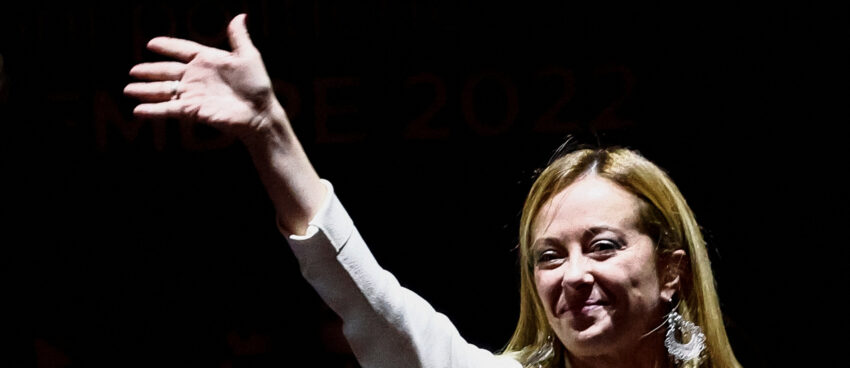
Italy’s prime minister is far more popular than Emmanuel Macron and Olaf Scholz
Publicado en The Economist, el 21 de octubre de 2024
THE POLITICS of Italy have long been trapped in a cycle of rancid interaction between judges and prosecutors on the one hand and conservative politicians on the other. It dates from at least 1994, when the then-prime minister, the late Silvio Berlusconi, was served with a subpoena while hosting a conference in Naples on organised crime. Berlusconi and his outraged supporters claimed he was a victim of politically motivated jurists—and repeated that claim ad nauseam over the years that followed.
On October 21st similar accusations were heard as Giorgia Meloni’s right-wing cabinet met to discuss its response to another dramatic judicial intervention. A court in Rome had ruled that 12 migrants, shipped to Albania, should be removed and taken forthwith to Italy. The ruling came just days after two Italian-built centres for receiving and holding asylum-seekers had been proudly unveiled at the launch of a €670m ($730m) scheme for outsourcing Italy’s immigration problems. The government’s response was to pass a decree that aims to get around the problem by designating a list of countries as “safe” for the return of people who are not assessed as genuine refugees; but there is no guarantee that the courts will not overturn it.
Ms Meloni now risks a protracted wrangle with the courts like that in Britain over the previous Conservative government’s plans to send migrants to Rwanda. Whether the affair erodes her support remains to be seen. But reducing the flow of migrants across the Mediterranean is central to Ms Meloni’s mission. And if the centres stand empty for long, they will become the butt of comedians’ jokes and taxpayers’ criticism.
The abrupt suspension of the scheme is the most embarrassing rebuff that Ms Meloni has suffered since taking office two years ago. Until last week indeed, she and her Brothers of Italy (FdI) party had enjoyed a remarkably smooth ride. Partly that is a matter of luck. The opposition to her government is rancorously split between the centre-left Democratic Party and the maverick Five Star Movement. The Brothers’ coalition partners, the more moderate Forza Italia party led by Antonio Tajani and the more radical League headed by Matteo Salvini, bicker incessantly but show no sign of defecting. Italy’s economy has grown, albeit modestly considering the amount of money thrown at it: some €208bn is coming from the EU as part of its programme for reversing the post-pandemic slump; yet more is being pumped out of the treasury into the real economy in the form of lavishly generous home improvement subsidies introduced by a previous government.
But her good luck should not detract from a recognition of Ms Meloni’s skills as a political and diplomatic tightrope walker. Take the manoeuvring that followed the European Parliament elections in June. Miffed at being shut out of the talks that crafted a renewed appointment for Ursula von der Leyen as president of the European Commission, Ms Meloni abstained from approving her reappointment in the European Council and the Brothers gave Mrs von der Leyen the thumbs-down in the European Parliament. That aligned them with the EU’s most Eurosceptical and pugnaciously rightist elements.
Italian opposition MPs were appalled. Commentators warned the prime minister had scuppered any chance of Italy obtaining a heavyweight economic portfolio. In the event, nothing of the sort happened. Ms Meloni’s candidate, Raffaele Fitto, is set fair to become a Commision vice-president. And, once his appointment has been approved by the European Parliament, his responsibilities will include the pandemic recovery fund of which Italy is by far the largest beneficiary.
By not backing Mrs von der Leyen, Ms Meloni not only pre-empted sniping from the more hardline League; she also equipped herself with an insurance against Donald Trump’s return to the White House, getting into his good books by siding with the right.
At home, Ms Meloni has played a similarly deft, ambiguous game. A potentially controversial constitutional reform has been delayed and will probably not be put to a referendum before the end of the current legislature in 2027. Her government’s management of the economy has been sensible enough, though free of any real effort to tackle its structural weaknesses. Next year’s draft budget, which imposes cuts to rebalance the public accounts, might have been written in Brussels.
More radical action has been reserved for social issues. The most recent example is a law, approved by parliament on October 16th, criminalising people who travel abroad to arrange a surrogate pregnancy. But, as with previous such initiatives, it targets a limited section of the population, made up of people who would anyway probably never vote for the Brothers.
At least three questions hang over the remainder of Ms Meloni’s term. One is whether the cumulative effect of such “culture war” incursions could turn Italy into a much less liberal country, aligning it more with central than western Europe. Another is whether, in the absence of reform, a slow-growing economy could cause the government problems in the financial markets. Public debt, which had fallen, is expected to rise to almost 140% of GDP by the end of 2026. But tax revenues this year have been higher than forecast and analysts seem untroubled. On October 18th Fitch, a ratings agency, revised its outlook for Italy’s long-term debt from “stable” to “positive”.
A less quantifiable risk concerns Ms Meloni’s micro-managerial style. “She wants to control everything,” says Giovanni Orsina, professor of contemporary history at the LUISS university in Rome. “And she doesn’t trust anyone. She could overload herself—or lose touch with reality.”
But for the moment the reality is that Ms Meloni enjoys an approval rating of more than 40%—twice as high as those of President Emmanuel Macron of France and Chancellor Olaf Scholz of Germany. Not bad for a prime minister approaching the mid-term point at which leaders’ popularity often crashes.