
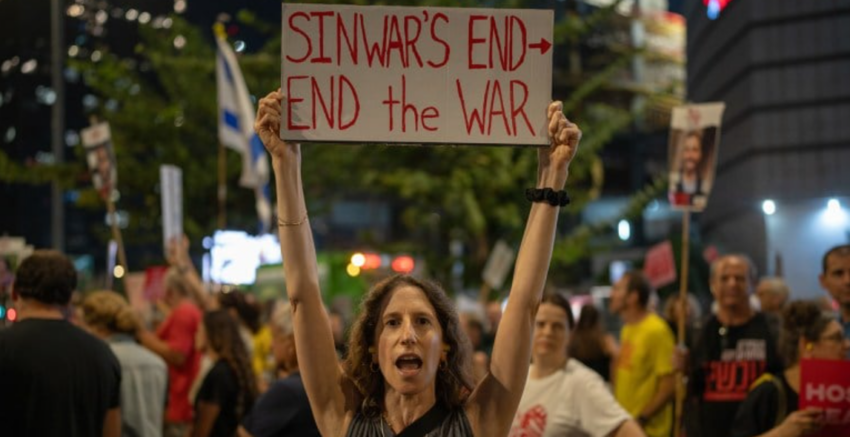
Hamas leader Yahya Sinwar, one of the masterminds of the Oct. 7, 2023, attack on Israel, was killed in an Israeli military operation in the Gaza Strip on Wednesday in the most significant blow to the militant group since the start of the war.
Publicado en FP el 17 de octubre de 2024
The Israeli military confirmed in a post on X on Thursday that Sinwar had been “eliminated.” “Justice has been delivered. Every single terrorist who harms Israelis will pay the price,” Israel’s Ministry of Foreign Affairs wrote on X.
Sinwar was a singular figure who shaped Hamas in his image, and he will not be easily replaced, experts said. His death could have profound reverberations for the course of the war and the future of the militant group.
“Sinwar had very unique attributes,” said Ghaith al-Omari, a former Palestinian Authority negotiator and a senior fellow at the Washington Institute for Near East Policy. “He was someone who had very strong standing in both the political and military wing[s]” of the organization.
Cold-blooded and calculating. As Hamas’s leader inside Gaza since 2017, Sinwar had long dominated the group’s military wing, and he was one of the principal architects of the bloody Oct. 7 attack on southern Israel alongside Hamas military chief Mohammed Deif, who was reportedly killed in an Israeli airstrike in July.
Sinwar took over leadership of the group’s political wing as well following the assassination of its former leader, Ismail Haniyeh, in July, further consolidating his power. U.S. officials have said in briefings with reporters that they believed that Sinwar had long had the final say on the group’s position on a potential cease-fire and hostage release deal.
Widely regarded to be cold-blooded and calculating, Sinwar formerly served as the chief of Hamas’s internal security unit, which was responsible for identifying and often killing Palestinians suspected of collaborating with Israel and those who violated Islamic morality laws.
Sinwar had not been seen in public since Oct. 7, 2023, and was believed to have been hiding in underground tunnels in Gaza.
Succession crisis. Who succeeds Sinwar could have a profound impact on the group’s direction and the prospect for reviving negotiations with Israel. From the military side, a likely contender would be Sinwar’s younger brother, Mohammed Sinwar, Omari said. The junior Sinwar is thought to be as ruthless as his older brother, Omari added, but he lacks his heft and may struggle to unite the military wing, which has been heavily degraded during the war.
Potential options from the political wing include Khalil al-Hayya, a member of Hamas’s Political Bureau and one of the group’s senior negotiators in Doha, and Khaled Mashal, a longtime senior Hamas official. Both Hayya and Mashal were seen as front-runners to replace Haniyeh as political leader following his assassination, though Sinwar ultimately got the job.
Mashal, who has not lived in the Palestinian territories since he was 11 years old and splits his time between Doha and Cairo, is thought to be more susceptible to external pressure than Sinwar, which could provide an opening for negotiations. Yet it’s unclear how that would translate in Gaza, where he does not have control over fighters, said Khaled Elgindy, a senior fellow at the Middle East Institute and an expert on Palestinian politics.
Hamas’s relationship with Iran, its key backer, could be complicated if Mashal were to become the new leader. Mashal supported a Sunni-led uprising against Syrian President Bashar al-Assad in 2011, alienating him from Tehran.
“Mashal has long wanted to basically move Hamas away from the Iranian axis to the Arab axis,” Omari said.
A complicated victory. While Sinwar’s death will undoubtedly be celebrated as a major victory in Israel, chaos unleashed by the leadership vacuum in Gaza could prompt the group to lash out by launching rockets at Israel or killing hostages, analysts said.
“It’s very likely that Sinwar has a series of scenarios put in place for his eventual death,” said Ahmed Fouad Alkhatib, a senior fellow with the Atlantic Council’s Middle East programs.
“This is a critical, time-sensitive development as it relates to the hostages,” Orna and Ronen Neutra, whose son Omer is being held in Gaza, said in a statement on Thursday. “Their lives are in great danger now more than ever.”
Many in Gaza will likely also welcome Sinwar’s death, Alkhatib said, as he was reviled for his callous disregard of Palestinian civilians’ lives. “He’s largely viewed as a psychopath who has taken Hamas not only in a more extreme direction but has made decisions during his tenure that have worsened prospects for Gaza’s development,” he said.
Analysts initially thought that Sinwar’s death could provide Israel an off-ramp to declare victory in Gaza, noting that the Biden administration would likely urge Israeli Prime Minister Benjamin Netanyahu to do so.
“This moment gives us an opportunity to finally end the war in Gaza,” U.S. Vice President Kamala Harris said during a campaign visit to Milwaukee. “It is time for the day after to begin.”
But in a speech on Thursday, Netanyahu vowed to continue with “full force” until the hostages are returned. Almost 100 hostages remain in Gaza, and Israeli officials estimate that around one-third may be already dead.