
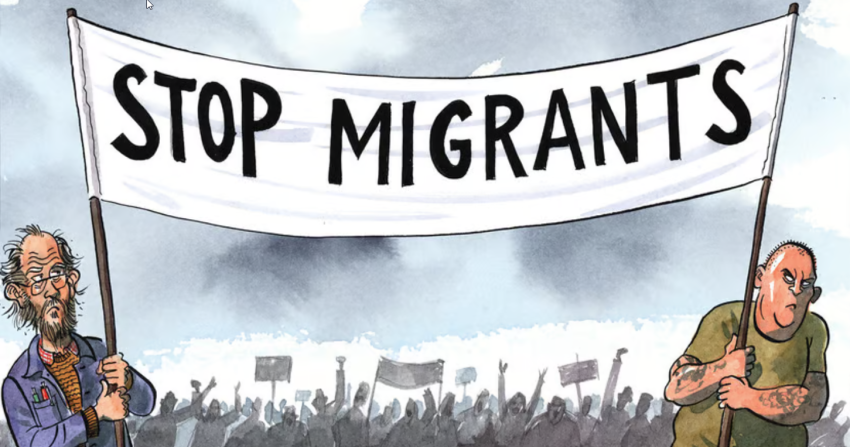
Xenophobia is crossing the political spectrum
Publicado el 29 de agosto de 2024
As Europe faced a sharp rise in the arrival of migrants seeking asylum in 2015, many national governments demanded more be done to stem the flow. Sweden’s prime minister disagreed. “My Europe does not build walls,” Stefan Lofven, leader of the Social Democrats, thundered in response, exuding the high-mindedness left-wingers muster at will. A couple of electoral setbacks later—it turns out voters are rather keen on walls during migration crises—the party is speaking from a different register, this time as an opposition force. “The Swedish people can feel safe in the knowledge that Social Democrats will stand up for a strict migration policy,” Magdalena Andersson, its current leader, said in an interview to a local paper in December. Remember peace, open borders and the socialist brotherhood of man? Not Mrs Andersson. “Free immigration is not left-wing,” she now argues.
Migrant-bashing has had a good run of late in Europe, largely as a result of the xenophobic hard right gaining ground across the continent. But these days it is not just the ideological allies of Marine Le Pen in France or Geert Wilders in the Netherlands banging on about new arrivals, or the integration of old ones. Parties on the other end of the political spectrum sometimes join in. On September 1st Sahra Wagenknecht, a German stalwart of the radical left, is expected to do well in two state elections, with a third to come later in the month. Polls show that in some contests her one-woman band, launched in October, will beat all three parties of the ruling coalition. Beyond wanting to soak the rich, it is Ms Wagenknecht’s overt animosity to migrants that stands out. Her claim there is “no more room” to take in refugees is the kind of rhetoric that has helped propel the nationalist Alternative for Germany (AfD) to the top of the polls. A stabbing spree by a Syrian failed asylum-seeker that left three dead on August 24th would once have delivered a windfall to the hard right. This time it is likely to help Ms Wagenknecht’s lot just as much.
Is the left simply aping the xenophobic right to siphon off some of its votes? If so, it is becoming a proven strategy. In Denmark Mette Frederiksen, prime minister since 2019, has inserted a hefty dose of hard-nosed policy on migration into her centre-left party’s programme. Far from reversing her conservative predecessors’ tough rhetoric on new arrivals, she made it her own. So-called “ghettos” with lots of migrants and crime (or just poverty) have been razed in a bid to force newcomers to integrate. Some refugees from Syria have been told their country is now safe enough to return to. A plan to deport asylum-seekers to Rwanda so they could be processed there was mooted. The strategy horrifies many socialists beyond Denmark—but is popular. With the exception of tiny Malta, Ms Frederiksen is the only centre-left leader in Europe whose party is both in office and ahead in the polls.
Part of the left, especially its revolutionary fringe, has long been uncomfortable about migration. Karl Marx saw the importation of foreign labourers as a ploy by capitalist bosses to keep the proletariat down. His French disciples among communists and trade unionists were among the most ardently opposed to open borders. A softening of that policy in the 1980s left the door open to Ms Le Pen’s father to build a truly xenophobic political movement, often pitched to the same working-class electorate. Jean-Luc Mélenchon, France’s latest firebrand of the left, has advocated against the right of European Union citizens to settle in France. For him, migration is at its root an exploitation of the migrant.
More centrist lefties have long been relaxed about immigration. That is in part because mainstream social-democratic parties that once catered to blue-collar types—those worried about jobs going to foreigners—have been taken over by college-educated yuppies for whom inclusion trumps class warfare. But even that bleeding-heart urban electorate occasionally questions the effects of letting in lots of new people. Some, like David Goodhart, a British thinker of the left, argue that high levels of migration undermine support for the welfare state. The solidarity required to enforce redistribution rests on the belief those in need are “people like us” that have merely fallen on hard times. Carsten is happy to bail out Torsten, whose values he shares. But what about Ahmed? Too much diversity frays societal bonds. America never fully developed a welfare state in part because those in need (often blacks or hispanics) did not look like those with plenty.
I’m not racist, but…
For those on the front lines of political life, rather than in its ivory towers, the left’s shift to grappling with migration feels overdue. Yes, xenophobes exist. But even open-minded voters worry about migration for all sorts of legitimate reasons, including the strain on housing and public services. In some places, notably Sweden, a rise in gun crime can be tied back to a rise in poorly integrated migrants. Yet in the political centre, and particularly on the left, omerta prevailed for years. Merely talking about the effects of migration was “doing the far right’s bidding”; voters would always “prefer the original to the copy” at the ballot box.
The result was that an issue voters care about was mostly brought up by parties with abhorrent views. If that is changing, so much the better. Signs are it might be. Plenty on the left talk about being “pro-integration” rather than “pro-migration”, ie, dealing with foreigners already here rather than allowing more to come. At the EU level, socialists in May voted for a new “migration pact” that will make life tougher for illegal migrants—including building the metaphorical walls Mr Lofven once objected to. The debate around immigration requires nuance: welcoming people is a boon to society if handled well (not to mention a moral obligation when dealing with refugees) but can be a burden if not. It is one the left should not be left out of.