Questions of authenticity and loss hang over new works.
Publicado en Foregin Policy, el 24 de febrero de 2024
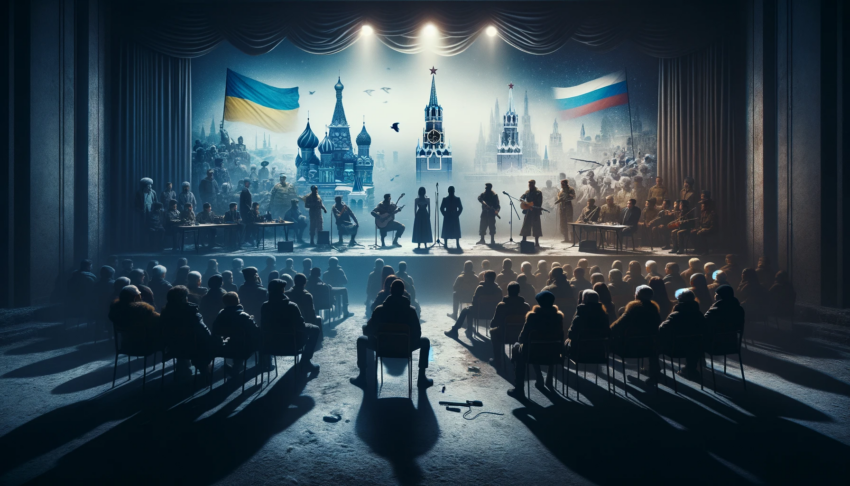
When Russia first invaded Ukraine in 2014, annexing the Crimean Peninsula and bringing turmoil and destruction to Ukraine’s eastern regions, many people—both outside Ukraine and inside it—found it easier to ignore the violence unfolding in the country’s east than admit that war had returned to Europe. This included creative artists, who rarely mentioned the war in their works, not least because they feared scaring off the Russian fans who constituted much of their audience.
As Ukrainians all over the country woke up to explosions on Feb. 24, 2022, the truth could no longer be ignored: The “big war” had truly begun. Today, the country’s art is catching up to the truth of war.
Before 2022, few Ukrainian artists and entertainers openly mentioned the ongoing war in their works. In fact, many pop stars like Ivan Dorn or Luna continued to perform in Russia and created works aimed, first and foremost, at the Russian market and in the Russian language. When criticized for this by their Ukrainian fans, many dodged the subject, claimed to be “apolitical,” or explained their actions as “trying to build a bridge” between Russia and Ukraine.
“My music isn’t about politics, it’s about healing souls,” Luna said in a lengthy interview with Russian opposition journalist Xenia Sobchak in 2021. “That’s why I don’t pay attention to the critics back home trying to make me feel guilty for giving concerts in Russia.” Similarly, Dorn claimed that by interacting with Russian listeners he was “trying to capture as many people as possible with my music so that they would never attack my own country.”
But the main reasons were pragmatic ones: The large and relatively rich Russian market has long been attractive to Ukrainian performers, much like the American market for the English-speaking world. Making films or music built around a Ukrainian context could scare off Russian fans, so the overwhelming majority of content made in the 2000s and 2010s was tailored to sound and look as neutral as possible, devoid of any references to local events or personalities. There were, of course, notable exceptions.
Musicians, such as singer and veteran military paramedic Anastasiia Shevchenko, better known by her pseudonym СТАСІK, wrote songs openly referencing the war in their lyrics and music videos. Indie rapper Stas Koroliov released an entire album in 2021 of tracks inspired by the war and society’s apathy toward it. It contained lyrics like “I now understand that to become a messiah you just need to state the obvious: My homeland is at war with Russia.”
While mainstream comedies that wanted both Ukrainian and Russian box office sales steered clear of any references to recent domestic events, independent movies were more willing to process the violence taking place in Ukraine’s eastern regions and the loss of Crimea. Wartime dramas such as Tymur Yashchenko’s U311 Cherkasy (named after the naval mine sweeper blocked by Russian forces during the capture of Crimea) and Maryna Er Gorbach’s Klondike addressed specific events of the Russo-Ukrainian war, while Nariman Aliev’s 2019 drama Homeward was a meditation on what the loss of Crimea meant for its indigenous Tatar population. Other films, such as Volodymyr Tykhyi’s dramedy Our Kitties, tried to find humor amid the heartbreak and horrors faced by the Ukrainian soldiers stationed on the frontlines.