
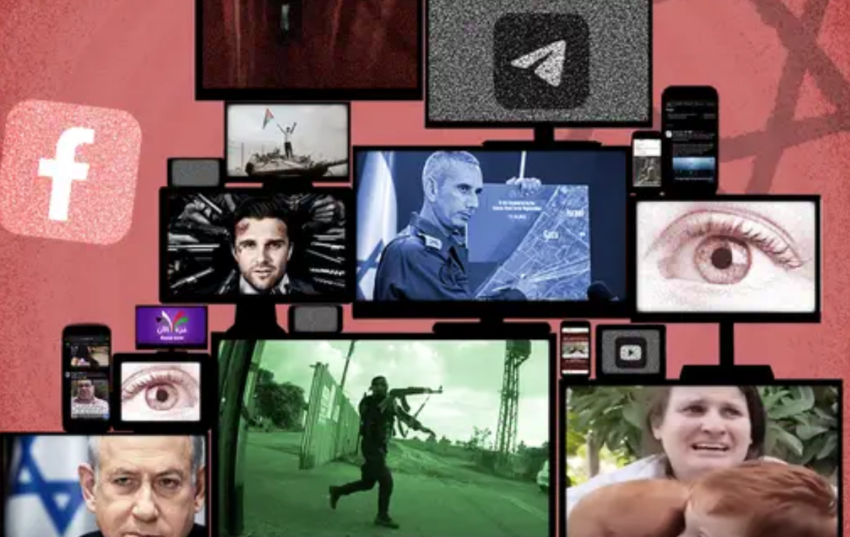
Defense, intelligence and civilian bodies realized soon after October 7 they were losing the online battle to what sources call Hamas’ ‘well-oiled psychological and information warfare machine.’ So they quietly purchased digital tools to fight disinformation, despite fears of future political misuse
Publicado en Haaretz, el 16 de enero de 2024
Israel has responded to its «clear loss» to Hamas on the digital battlefield by making its first-ever purchase of a technological system capable of conducting mass online influence campaigns, according to numerous sources with knowledge of the matter.
The system can, among other things, automatically create content tailored to specific audiences. The technology was purchased as part of a wider attempt by Israeli bodies, both civilian and military, to address what sources termed «Israel’s public diplomacy failure» following the Hamas massacre on October 7 and subsequent war.
According to eight different sources active in the worlds of intelligence, technology, online influence and public diplomacy, Israel was ill-equipped for the social media war that erupted on Black Saturday. This resulted in a «credibility crisis» that has, from Jerusalem’s perspective, hindered the Israel Defense Forces’ ability to act against Hamas on the actual battlefield.
Though initially conceived in military terms as a solution to intelligence and psychological warfare needs, sources say the system is currently being operated by a governmental office. The reason: concerns in the defense establishment over operating a «political» technology.
According to sources knowledgeable about Israel’s public diplomacy efforts – «hasbara,» as it is termed in Hebrew – the system is intended to counter what they and researchers termed a well-oiled online «hate machine» systematically pushing out anti-Israeli and pro-Hamas disinformation, misinformation, October 7 denialism, as well as blatantly antisemitic content.
These messages were aided by technologically backed campaigns from forces in Iran and even Russia. Together, sources say, these campaigns were not only undermining Israeli efforts to report on Hamas atrocities, but also undercut the rationale behind the war and the IDF spokesperson’s credibility – specifically among younger audiences in the West.
Only on Monday did the Israeli Shin Bet reveal that Iran was operating at least four fake channels across Israeli social media as part of its psychological warfare and influence operations aimed at Israel. Among them was a fake online network previously revealed by Haaretz that also helped amplify Hamas videos from the October 7 attack and has since worked to incite the Israeli public on issues linked to the war.
The first campaign is already up and running. It has nothing to do with the war, though, focusing instead on antisemitism.
Israel, via the Prime Minister’s Office, which controls the Public Diplomacy Directorate and other bodies, rejected all of the claims in this story.
The PsyOp front
The first hour of the war revealed how hopelessly unprepared Israel’s defense establishment was for handling social media platforms like Instagram and TikTok, and even messaging apps like Telegram, as the internet (and Israeli society) was flooded with videos filmed by Hamas documenting their own atrocities.
Israeli high-tech workers and firms immediately stepped up to fill the void: As part of a volunteer «war room,» technology for mapping social media platforms or even facial recognition abilities were developed not for influence but to help identify terrorists and find hostages, to name but two examples.
However, as time passed and the actual war intensified, these passive abilities proved to be only half of the battle: Israel also had active needs and lacked the ability to push out information. Sources say the defense establishment – specifically the intelligence community – discovered there was a «dire national need» for influence to counter Hamas’ information warfare, amid genuine widespread destruction and death in Gaza.
The goal was to counter what sources said were inauthentic efforts to delegitimize Israel online: bad faith moves that researchers say have also enjoyed algorithmic support from social media platforms.
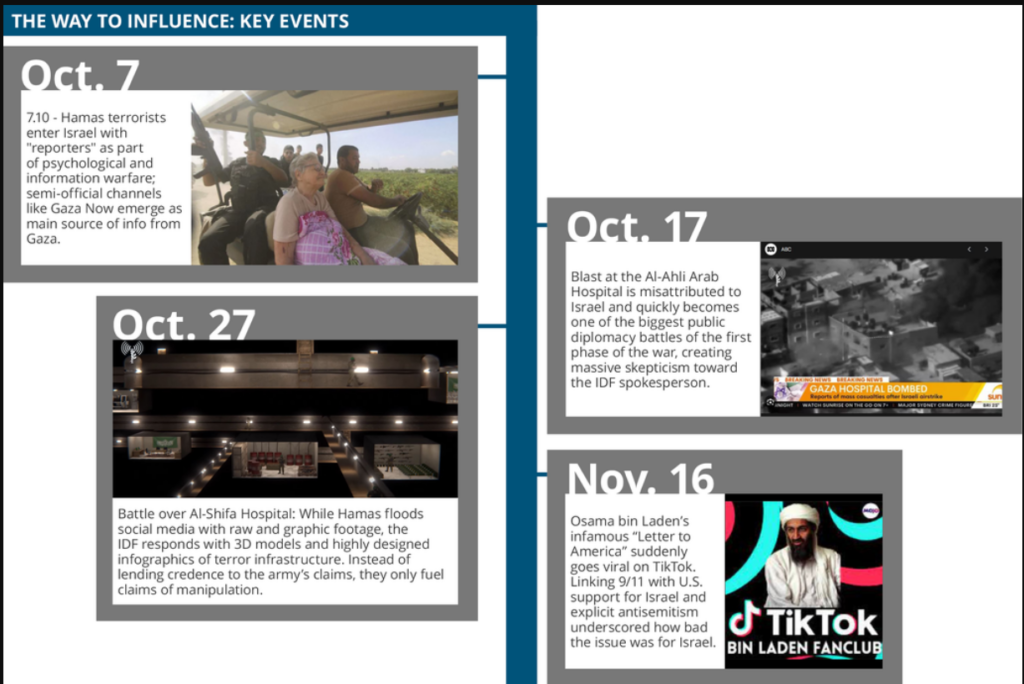
Since the start of the war 100 days ago, Hamas has led a massively successful public communications campaign, which sources describe as a «PsyOp» – 0r a «psychological» influence operation. Alongside the terrorists who infiltrated Israeli communities on October 7, Hamas also brought along «reporters» to broadcast live from within the kibbutzim.
Since then, semi-official communication channels – the most successful of which is Gaza Now, which has millions of subscribers on Telegram – have become the go-to source for information from Gaza, documenting the Israeli attacks from the ground.
The IDF Spokesperson’s Unit was found to be limited in its ability to actively counter this seemingly endless flow of visual materials being pushed out by Hamas and its proxies. Furthermore, as time passed, Israelis found that these propaganda efforts were also being amplified across social media by various pro-Palestinian users, including many who were acting in good faith.
Israeli officials and social media researchers highlight the distinction between three forms of online content in this regard:
- Anti-Israel posts expressing political support for the Palestinians and opposing Israel’s conduct, which fall under free speech;
- False, misleading or hateful content that runs afoul of social media’s internal trust and safety policies, and can be removed by moderation teams if flagged;
- Violent, graphic and pro-terrorist content that is considered illegal and can be taken down following an official request from Israel’s Justice Ministry.
Israeli civilian volunteers have tried to make Israel’s case online, as well as reporting posts that break platform rules. In theory, the Foreign Ministry and the Public Diplomacy Directorate are supposed to assist with official hasbara efforts. However, despite years of generous funding and prestige, which some say bred overconfidence, these bodies were late to the game and, sources say, were found to be irrelevant in terms of helping to address the defense establishment’s new needs.
While Israeli officials have no expectation of enjoying massive support online, they say the wider popular support for the Palestinian cause has been successfully hijacked by Hamas to undermine Israel’s standing in an unprecedented way. Officials say the sheer scale of content produced by Hamas and its affiliates, as well as its organic reach – especially among young Westerners – caught Israel unawares.
Backed by algorithms long known to prioritize polarizing content, Hamas propaganda videos and talking points went viral again and again: Outrageous libels about the IDF and nefarious attempts to justify denial of Hamas crimes against Israeli civilians soon morphed into systematic attacks on the army’s credibility.
Despite Israeli efforts, which included both civilian and official attempts to map and report such content, and even personal outreach from local high-tech leaders to social media executives abroad, a deluge of fake, graphic, violent or antisemitic content flooded the internet during the first two and a half months of the war.
According to some researchers, about 3o percent of content deemed to be the most graphic, the most violent and the most illegal still remains online.
Antisemitism and anti-Jewish incitement emerged as another major issue online, researchers and officials noted – another ramification of how the war caught Israel off guard.
«It’s not even about our right to respond to the events of October 7 in the way we did as a military – or even actively fight denialism about rape or counter clearly false information,» a former senior intelligence official explained. «This is a battle about the very legitimacy of Israel to exist as a state with an army. In that sense, Hamas has already won.»
A lesson from bin Laden
As the weeks passed, defense officials realized that Israel had no way to actively respond to Hamas’ online efforts.
«Hasbara is one thing – that’s when I explain why my side is good and the other side is bad. But influence is something else: it has to do with our ability to create a perception or conception that helps my interests as a state. Influence is the ability to shift or sway someone, move them from point A to point B,» explains a former senior official in the Israeli intelligence community.
According to them and others who spoke with Haaretz, «Israel was caught completely unprepared on October 7 in this regard.» The existing psychological warfare units focused almost exclusively on Arabic and Farsi, and were irrelevant for this particular war.
While Hamas flooded social media with raw and graphic footage from the fighting, the IDF responded with intricate 3D models and highly designed infographics showing the terror infrastructure beneath the site. Instead of lending credence to the army’s claims, they only fueled claims of manipulation.
The first incident that helped underscore the issue was the October 17 blast at the Al Ahli Arab Hospital in Gaza City, in which the Hamas-controlled Health Ministry instantly said 500 people were killed. The attack was attributed to an Israeli airstrike, which the IDF immediately refuted, releasing audio and video footage for days suggesting it was a malfunctioning Palestinian rocket. The incident became one of the biggest public diplomacy battles during the first phase of the war, setting off riots in the Muslim world.
A week later, when human rights groups confirmed that a misfired Palestinian rocket was indeed likely to blame, the damage had already been done and skepticism of the Israeli account and of IDF officials only seemed to grow.
Gaza’s hospitals and Hamas’ use of them would become a key rallying point for Israel’s influence efforts – proof Hamas is active from deep within civilian centers and a clear sign of its use of innocent Gazans as human shields.
The physical battle over the Al-Shifa Hospital, also in Gaza City, coincided with another digital battle. But while Hamas flooded social media with raw and graphic footage from the fighting, the IDF responded with intricate 3D models and highly designed infographics showing the terror infrastructure beneath the site. Instead of lending credence to the army’s claims, they only fueled claims of manipulation.
The more Israeli forces penetrated Hamas’ tunnels and bunkers beneath Gaza’s main hospital, the less the narrative seemed to penetrate international perceptions of the war.
«A major gap was revealed in terms of the ability to conduct an influence campaign vis-à-vis specific missions: the goal was to give Israel time to act and showcase as much as possible Hamas’ real atrocities – but we simply didn’t have the relevant assets,» another former intelligence official says about the first month of the war.
And then Osama bin Laden re-emerged – at least, online. The watershed moment in terms of Israel’s understanding of the scale of the issue arrived when the Al-Qaida founder’s infamous 2002 «Letter to America» suddenly went viral on TikTok in mid-November. In it, he justified 9/11 as a punishment for U.S. support of Israel, while using explicitly antisemitic and eliminationist language.
When it became clear that Israel’s official hasbara efforts were having little effect, and that Israel had all but lost the battle for public opinion, an arms race for digital assets began to help push out information and content in parallel with the IDF spokesperson to help counter Hamas’ online operation.
«Everyone got calls – it was crazy,» says a source active in political influence campaigns. «It was also stupid. It takes time to build a good operation: you can’t just act like you would in a marketing campaign.»
Officials reached out to local firms and service providers active abroad, offering them the chance to help voluntarily by publishing online materials collected from security cameras in Israeli communities and GoPro cameras worn by Hamas militants that documented the October 7 massacre.
Some of these videos would later indeed be leaked online, alongside videos filmed by IDF soldiers fighting in Gaza itself. Last month, Haaretz revealed that the IDF Operations Directorate’s Influencing Department, which is responsible for psychological warfare operations against the enemy and foreign audiences, operates an unattributed Telegram channel called «72 Virgins – Uncensored.» This shows the bodies of Hamas terrorists with the promise of «shattering the terrorists’ fantasy.»
South First Responders, another Telegram group active in English, also published exclusive videos from the Hamas attack. The channel also seems to be the first to publish videos of the execution of Joshua Mollel, a Tanzanian national slayed during the Hamas attack.
Mollel’s family was informed, three days prior to the videos portraying his vicious murder, that he had died. They were invited to Israel to see the evidence but in the meantime, videos of his kidnapping and murder appeared «exclusively» on the page and later on Israeli social media accounts, including the Foreign Ministry. They were published with the hashtag «Black lives don’t matter» for Hamas. Mollel’s father told Haaretz their publication harmed the family.
«The need, from Israel’s perspective, was to dilute the value of the videos Hamas was pushing out and allow Israel some way to publish content of its own from the field too,» one of the sources explained.
The hasbara paradox
The issue posed a tough challenge from Israel’s perspective: Hamas had successfully utilized not just the very real death and destruction in Gaza, harnessing the humanitarian crisis to win over hearts and minds, but also weaponizing disinformation against Israel: rape denialism, bogus claims regarding the Israeli death toll or the role of IDF friendly fire on civilian casualties at the Nova music festival, and others all managed to take root despite being false and amid repeated attempts to debunk them.
According to information obtained by Haaretz, a few weeks into the war, Israel set up a «hasbara forum» comprising government agencies, offices and ministries, as well as military, defense and intelligence bodies – including the IDF, the Shin Bet security service and the National Security Council – alongside tech firms, civilians volunteer initiatives and even Jewish organizations, that meets weekly.
Officials from different bodies, including the Public Diplomacy Directorate and Diaspora Affairs Ministry, charged with countering antisemitism against world Jewry, held talks with different firms and tech providers active in various mass online campaigns. Assets are one thing, an intelligence source explains, but you also want a system for managing them.
Mass influence systems can often get their operators in trouble, and their public exposure can severely damage their clients’ credibility. Every quarter, social media platforms like Meta disclose such operations and undermine their ability to keep operating effectively.
One of the sources explained the dilemma around purchasing such a technology from a defense body’s perspective: «On the one hand, you want scale to be able to effectively amplify your core message. On the other, operational security is critical.»
According to other investigations published in the past, operating such a system also requires some infrastructure.
As a result, Israel decided to purchase an existing technology instead of risk developing one independently. A number of civilian tools and programs developed for business and political campaigns were procured: a system for mapping online audiences; a system capable of automatically creating websites, among other things, as well as content tailored to specific audiences; a system for monitoring social media and messaging platforms, and others. Thus, Israel hoped to launch campaigns that would advance Israel’s core message and improve global perception.
A mass online influence system was revealed last year as part of the «Team Jorge» investigation led by TheMarker and Haaretz, and published internationally as part of the «Story Killers» project initiated by Forbidden Stories. In that case, a group of Israelis were selling disinformation and election interference as a service to private clients – parts of which also included use of a never-before-seen software for online influence campaigns.
Sources stress that this is not this case with Israel now. While those campaigns were political, acted in bad faith and used fake information to deceive people, the goal here is to amplify real information in the face of disinformation enjoying inauthentic support.
Throughout this process, sources say, the risks of buying or operating such a system were clear both to civilian and defense officials. These were also accompanied by concerns of political interference by the Prime Minister’s Office, which in addition to the Public Diplomacy Directorate, also oversees other bodies that examined the possibility of buying influence technology. Israeli television reported last month that a «significant security body» that was supposed to lead Israel’s influence operations voiced concern over potential political misuse or interventions.
In the end, the systems that were selected were purchased through intermediaries. Per sources who spoke with Haaretz, it was also decided that a governmental ministry, and not a defense body, would lead its usage.
As well as the Diaspora Affairs Ministry and the Public Diplomacy Directorate, the Foreign Ministry and even the Strategic Affairs Ministry, which was set up to fight delegitimization efforts – most famously through the failed anti-BDS influence project Kela Shlomo (Solomon’s Swing) – all deal with hasbara in theory.
The first campaign created by the system is already running online. The campaign is not in Hebrew and does not focus on the war at all, but instead on antisemitism and countering anti-Zionist narratives.
The Prime Minister’s Office denied the report and said in response: «Israel conducts its substantial international hasbara efforts openly.» The claims raised in this report, a spokesperson said, «are completely unknown to us and they never happened.»
Israel’s Diaspora Affairs Ministry said it funds some civilian campaigns, but, like the Public Diplomacy Directorate, denied the use of any such system.
Nonetheless, sources still voice concern over the move. It is unclear which Israeli body will oversee the system’s usage over time, and what will ultimately happen to it and the various digital assets that were purchased or created during the war.
«Influence has emerged as a strategic issue, yet that shoe has yet to drop – not at a national level, not at the military level and not even among civilian volunteers,» said a knowledgeable source. «Everyone needs to be synced up, but instead of one voice we have three different voices pulling in different directions,» they said, lamenting the trifold mess of ministries being led by politicians, defense bodies, and private initiatives from citizens and tech firms.
«The first weeks of the war were chaotic: the government bodies just bickered between themselves over credit and turf. Civilians, especially workers in high-tech and PR firms active in the so-called volunteer war rooms, really covered for them.»
After months of volunteer efforts, including massive investment of resources by local tech and advertising firms, the Diaspora Affairs Ministry has, sources says, finally started funding civilian projects and the volunteer effort is winding down, with the Public Diplomacy Directorate stepping in to try to sync up all the nonmilitary projects.
«It’s as if Israel discovered the internet for the first time on that Saturday in October,» an intelligence source says. «Israel has never really seen this as a real arena it needs to be active in. It takes time. But there’s no long-term planning, just like with education: zero investment.»