
The rise of the outsider candidate is a broader trend across the region
Publicado en The Economist, el 21 de agosto de 2023
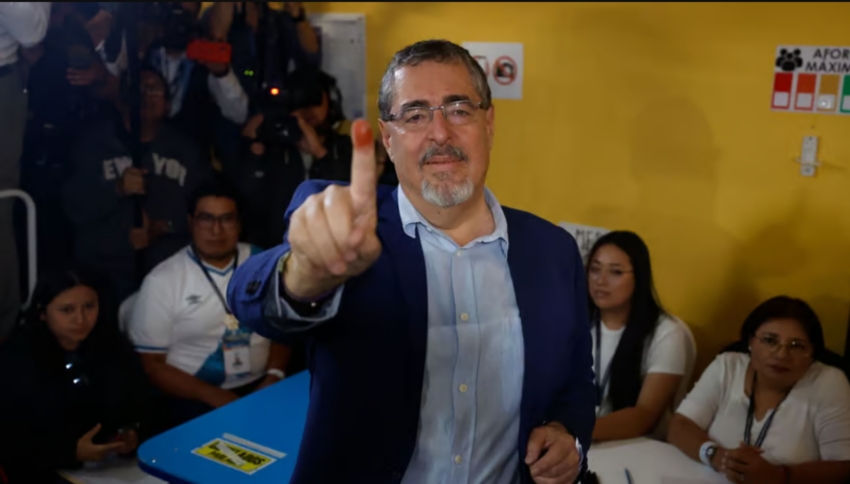
On august 20th voters went to the polls in Ecuador and Guatemala. Both elections had surprising results. In Ecuador, two candidates will now head to a run-off: Luisa González, a protégée of Rafael Correa, a former left-wing populist president, and Daniel Noboa, a 35-year-old who was polling in single digits a few days ago. In Guatemala the result was a landslide win for Bernardo Arévalo (pictured, above), a reformer who took 58% of the vote, far ahead of the 37% gained by Sandra Torres, a former first lady on her third (unsuccessful) run for the presidency. Both elections suggest that Latin Americans are fed up with the status quo.
Mr Arévalo, the son of Guatemala’s first democratically elected president, pledged to tackle corruption. This appealed to voters angry at the influence over the state exercised by a sprawling network of political, military and economic elites, which Guatemalans call “the pact of the corrupt”. Although Mr Arévalo has spent part of his career as a diplomat, his party, Movimiento Semilla (Seed Movement), is a relatively new progressive force, founded by academics rather than politicians.
Across the region, voters have long been restless at the chequered state of democracy. In Guatemala this appears particularly acute. In 2019, a un-backed anti-corruption body was shut down by a former president. Lawmakers are alleged to take money from drug traffickers and other corrupt actors in exchange for supporting their agendas. Under the outgoing president, Alejandro Giammattei, the courts have been stacked with loyalists to the political elites. Scores of independent-minded judges and journalists have fled the country.
Guatemalans in the capital celebrated Mr Arévalo’s victory with fireworks. Fears that the “pact of the corrupt” would scupper the election did not come to pass. Voting took place peacefully, although turnout was only 45%, lower than in the first round. There have not yet been any reports of worrying irregularities. Mr Giammattei was quick to congratulate Mr Arévalo and said he looked forward to working with him for the transition.
However, there are likely to be legal challenges between now and the inauguration in January. Early on three popular candidates were excluded from the race on dubious grounds (they appealed, with no success). Other political parties launched a spurious legal challenge to the vote following the first round in June. Another continuing case seeks to revoke Semilla’s legal status on the basis of irregularities in its registration (these are denied by the party). Still, Juan Carlos Zapata of Fundesa, an economic think-tank in Guatemala City, reckons that any challenges will be quickly resolved. “The difference [in vote] is quite compelling and the message of the voters was very clear,” he says.
Similarly, in Ecuador the electoral period has been turbulent. Just 11 days before the vote Fernando Villavicencio, a candidate campaigning on an anti-corruption platform, was shot and killed. This led analysts to believe that candidates who emphasised a law-and-order message, such as Jan Topic, would come out on top. Crime has rocketed in recent years: homicide rates have quadrupled since 2018 to 26 per 100,000 people per year, a rate higher than in Mexico or Colombia.
Instead, Ecuador’s result shows a deeply divided country. Ms González won 33% of the valid votes. Her success points to the staying power of Mr Correa, who ruled from 2007 to 2017 and later went into self-imposed exile in Belgium, where he worked as a host for Russia Today, a news channel linked to the Kremlin. In 2020 he was tried in absentia for corruption (which he denies) and sentenced to an eight-year jail sentence. Many voters may be nostalgic for his rule, which coincided with a commodities boom. Poverty rates fell and the country was relatively peaceful.
By contrast, Mr Noboa’s surprise second-place showing, with 24% of the votes, suggests that some Ecuadorean voters–particularly younger ones–want something different. Mr Noboa is the scion of one of Latin America’s richest families. He talks about boosting free-trade agreements and cutting taxes. He performed very well in the final presidential debate days before the election, coming across as calm, clear and collected. That may have swung indecisive voters. If he can win over those voters who plumped for the other centrist candidates, or to those who do not remember Mr Correa fondly, he could win in the run-off on October 15th.
The rise of unexpected candidates is not limited to these countries. Last week Javier Milei, a libertarian economist who was elected to Congress in 2021, won the most votes in Argentina’s primaries. He will now face more established politicians in the election on October 22nd. In Mexico, which holds its presidential election next year, Xóchitl Gálvez, a senator who comes from a poor background, has emerged as the key challenger to Claudia Sheinbaum, the mayor of Mexico City who is backed by Andrés Manuel López Obrador, the president (he cannot run again). Further surprises look likely in the coming weeks and months.