
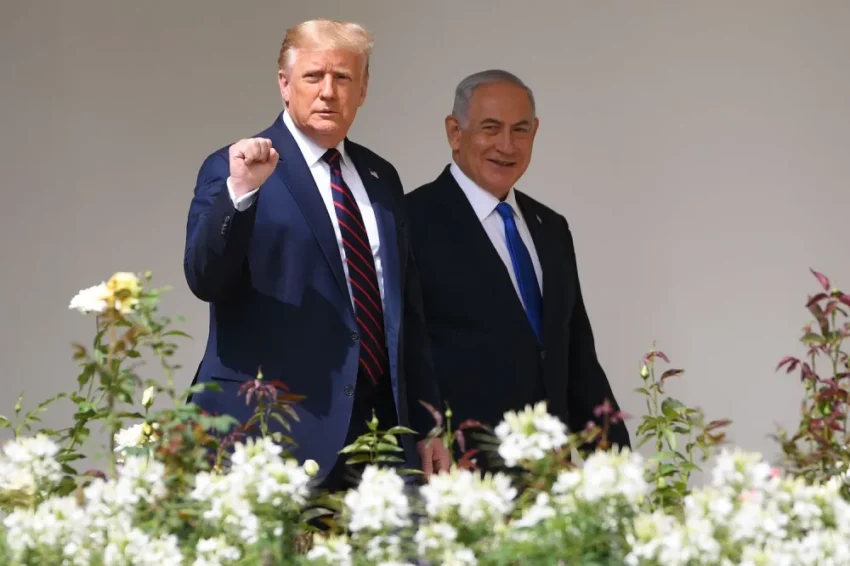
U.S. President Donald Trump will pressure Israeli Prime Minister Benjamin Netanyahu to adopt his 21-point-plan for ending the Gaza war when the two leaders meet in Washington
Publicado en The Soufan Center, el 29 de septiembre
- Netanyahu again categorically rejected the establishment of a Palestinian state in his speech to the UN General Assembly on Friday, but eventual statehood is one core tenet of the Trump peace plan.
- U.S., Arab, and European leaders support the main elements of the Trump plan, including assigning a central role to the West Bank-based Palestinian Authority for governing and securing Gaza over the longer term.
- Implementing the Trump proposal depends on substantial cooperation from the Arab states, which would be expected to provide a temporary security force for Gaza and the bulk of the funding for Gaza’s reconstruction.
In advance of a meeting with Israeli Prime Minister Benjamin Netanyahu at the White House today, and anticipating the second anniversary of the October 7, 2023, Hamas assault on Israel, U.S. President Donald Trump told reporters Friday that “It’s looking like we have a deal on Gaza.” He added: “…we’ll let you know. I think it’s a deal that will get the hostages back. It’s going to be a deal that will end the war. It’s going to be peace. I think we have a deal.” Trump’s optimism stemmed from the positive response U.S. officials received from Arab leaders for a new U.S.-designed “21-point-plan” to end the Gaza war. U.S. officials discussed the plan with regional leaders last week on the sidelines of the United Nations General Assembly (UNGA) meetings in New York.
Speaking at the separate Concordia Annual Summit, Trump’s top Middle East Envoy Steve Witkoff described a «very productive» meeting on Tuesday between Trump and officials from Saudi Arabia, the United Arab Emirates, Qatar, Egypt, Jordan, Türkiye, Indonesia, and Pakistan. He claimed the 21-point-plan “address[es] Israeli concerns as well as concerns of neighbors in the region.» Trump posted on his social media network that, “Intense negotiations have been going on for four days, and will continue for as long as necessary in order to get a Successfully Completed Agreement. All of the Countries within the Region are involved, Hamas is very much aware of these discussions, and Israel has been informed at all levels, including Prime Minister Bibi Netanyahu.” The U.S.’ statements indicated Qatar has resumed its key Gaza mediation role, which Doha suspended following the September 9 Israeli strike on a meeting of Hamas leaders in the Qatari capital.
At their White House meeting today, Trump will urge Netanyahu to sign on to the 21-point-plan, arguing it meets his core demands that Hamas disarm and no longer govern the Gaza Strip. Still, the plan is sure to encounter objections not only from Netanyahu but from Hamas leaders as well. According to texts of the plan published by Al Arabiya, the Times of Israel, and other media, the initiative provides for: a ceasefire; the immediate and unconditional release of all 48 remaining Israeli hostages (of which 20 are believed still alive); the release of more than 1,000 Palestinian prisoners, including between 100 and 200 serving harsh sentences; the unhindered entry of humanitarian aid delivered by international organizations and the UN; and the sidelining (although not necessarily complete closure) of the controversial U.S.-backed Gaza Humanitarian Foundation (GHF) relief program.
The elements of the Trump plan most likely to encounter objections from the warring parties center on its proposed “day after” arrangements for governing and securing Gaza. The plan reportedly provides for Gaza to be administered “temporarily” by a committee of Palestinian technocrats, supervised by a new international body established by the U.S. and its European and Arab partners. The West Bank-based Palestinian Authority (PA) would ultimately assume the primary role in governing the enclave, but only after the PA has been “reformed.” Safe humanitarian corridors would be created across the enclave, while internationally-funded reconstruction of Gaza would take place over five years, managed by an “international and Arab consortium.” The Trump team reportedly expects the Arab Gulf states to fund the bulk of the many billions of dollars it will cost to rebuild the largely destroyed enclave.
The component of the Trump plan that Hamas has, to date, resisted mandates that the group’s weapons are to be collected by an “international stabilization force” (consisting of Arab and European security personnel) that would deploy immediately after a ceasefire. The force would train and eventually give way to a Palestinian police force that would serve as the enclave’s permanent security body. Other reports note that Egypt has begun training thousands of Palestinian personnel who would serve in the Gaza force. Hamas members who forswear violence against Israel would be “pardoned,” whereas those who continue to subscribe to Hamas’ commitment to armed struggle would be given safe passage out of Gaza.
In an effort to garner Netanyahu’s backing, the Trump plan incorporates a unique “sweetener” for Israel and a pressure point that denies Hamas a veto over the proposal — it provides for partial or rolling implementation of the plan even if Hamas rejects the initiative. The text stipulates that if “Hamas delays or rejects this proposal,” the plan could proceed in “terror-free areas” of Gaza. In those areas now occupied by the Israel Defense Forces (IDF), the Israeli units would hand over their security mission to the international security force that is to deploy to the enclave.
The plan also offers incentives to Hamas and the Arab states. It provides for renewed “final status” talks between Israel and the Palestinians, leading to the establishment of an independent Palestinian state. Additionally, by mandating a “process … to de-radicalize the [Palestinian] population,” including through “interfaith dialogue aimed at changing mindsets and narratives in Israel and Gaza,” the plan seeks to blunt Netanyahu’s likely criticism that a Palestinian state would reject Israel’s existence. Saudi and other Arab leaders, including in their speeches to UNGA last week, uniformly insisted that establishing a Palestinian state is a non-negotiable condition of normalizing relations with Israel. On the sidelines of last week’s UNGA meetings, several major countries announced recognition of a Palestinian state, including Canada, Australia, the UK, Portugal, France, Belgium, Luxembourg, and Malta. Some reported texts also provide for the United States to guarantee that Israel refrains from annexing the West Bank — a point demanded by the Arab states. Another clause in the plan commits Israel not to carry out future strikes in Qatar.
Hamas has not commented on published reports about the Trump plan, and it is not clear whether the concept has been presented to Hamas officials by mediators in Qatar or Egypt. The plan’s provision for Hamas’ disarmament, and the exile of hardline Hamas members from Gaza outright, is sure to attract objections from Hamas negotiators. Hamas’ resistance to disarming has contributed to the failure of the many Gaza peace plans offered by various mediators over the past 18 months. And, accepting the plan in its current form would mean that Hamas forfeits its longstanding aspirations to lead the Palestinian national movement and accepts battlefield defeat.
On the other hand, leaders of the PA, which is dominated by the Fatah faction of the Palestine Liberation Organization (PLO), will see the Trump plan as furthering their objectives. The Trump plan offers the PLO the opportunity to regain full control of the Palestinian national movement from a weakened Hamas, although hardliners aligned with Hamas and other rejectionist factions will still command significant followings among Palestinians. Last week, PA President Mahmoud Abbas, speaking in a recorded UNGA address after being barred from entry to the U.S., expressed support for a Saudi-French plan that was unveiled at a summit on Monday at the sidelines of UNGA. Much of that initiative is identical to Trump’s proposal. Abbas stated: «We declare that we are ready to work with U.S. President Donald Trump and with the Kingdom of Saudi Arabia and France, the United Nations and all partners to implement the [Saudi-French] peace plan … in a way that would lead towards a just peace and regional cooperation.»
Still, U.S. leaders anticipate that, when Trump and Netanyahu meet today, the Israeli Prime Minister will demand significant amendments to the 21-point-plan. He is likely to reject, in particular, the plan’s roadmap for establishing a Palestinian state. He reiterated his opposition to a Palestinian state in his speech to UNGA on Friday, saying: “Giving the Palestinians a state one mile from Jerusalem after October 7th is like giving Al-Qaeda a state one mile from New York City after September 11th. This is sheer madness. It’s insane, and we won’t do it … Israel will not allow you to shove a terror state down our throats.” And, despite the Trump plan’s promise that Gaza will be a “de-radicalized, terror-free zone that does not pose a threat to its neighbors,” Netanyahu will likely also pressure Trump to drop the plan’s assignment of a central postwar governing role to the PA and the PLO. In his UNGA speech, Netanyahu sought to preempt U.S. insistence that the international community can reform the PA, stating: “… I hear from the Western Leaders. They tell me the PA promised us it will reform … We’ve heard these promises for decades. They always promise. They never deliver. The Palestinian Authority is corrupt to the core. They haven’t held elections in 20 years. They use the same textbooks as Hamas. Exactly the same textbooks. They teach their children to hate Jews and destroy the Jewish state.” The Trump plan’s incorporation of elements both Israel and Hamas consider objectionable might frustrate Trump’s estimate that a Gaza solution is finally at hand.