
Artículo de Lawrence Freedman, publicado en Sam Substack
The notorious Igor Girkin has observed that ‘The war in Ukraine will continue until the complete defeat of Russia. We have already lost, the rest is just a matter of time.’
What Next
Russia is losing but it has not yet lost. It still occupies a large chunk of Ukrainian territory and still has substantial military assets in the country. As I have argued regularly in these posts wars can take unexpected turns, as we have just seen. Calamitous miscalculations as well as audacious manoeuvres can transform the character of a new conflict. There is always a risk of analyses getting too far ahead, jumping from the current state of affairs to the next and beyond and then asking what happens in purely hypothetical situations. Earlier in the summer there was a tendency to assume that the coming months would be dominated either by more gruelling Russian offensives as in the Donbas or perhaps a stalemate, so that the war could last months or even years. This stalemate philosophy still persists, not least because it is hard to even contemplate such a great military power being humbled.
So while the situation is far more positive for Ukraine the same cautions about extrapolating too far ahead must apply. Even if Kharkiv is completely liberated there will still be much to do. In the Kherson Oblast the other offensive is also developing and taking shape. This has so far been in the ‘slow grind’ category though it is picking up pace and more encirclement operations are possible there. The Russians must now be worrying about their position in Donetsk. Unresolved is the extraordinarily dangerous situation at the Zaporizhzhya Nuclear Power Plant. This is an unsustainable situation, one the Director-General of the IAEA has described as ‘precarious’ as the plant’s offsite power has been turned off and it is still being shelled.
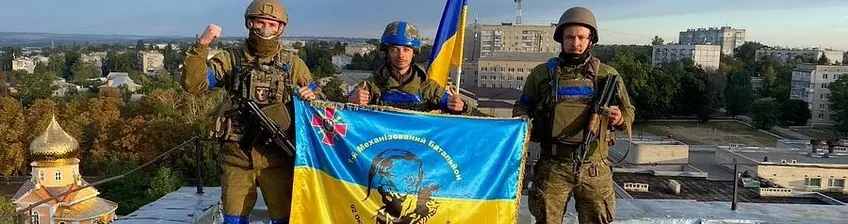
The initiative is now firmly with Ukraine. The experience of the last few days will create doubts in the minds of Russian commanders about the reliability and resilience of their troops, and add to the predicaments they already face when working out how to allocate their increasingly scarce resources of manpower, intelligence assets and airpower. Might they risk a repeat of this operational disaster if they move forces to plug one gap only for another to open up? How much more can they expect from their forces, many who will now have been fighting for long weeks without respite and without much to show for their efforts? By contrast, there will have been a boost to the morale of even the more beleaguered Ukrainian forces (and as the Washington Post reports some of their units have also had a tough time). There may also have been a boost to their capabilities from supplies of equipment and ammunition captured in Kharkiv.
There is now talk of defeat on the Russian side. There was no sense of this in President Putin’s insouciant remarks at the Vladivostok economic forum, with Russia’s isolation symbolised by the lack of international presence (Myanmar, Chinese and Armenian representatives turned up). He claimed that nothing had been lost by the war and sovereignty had been gained as if his desire to intensify autocracy and achieve autarky in the name of self-reliance has been worth the tens of thousands of Russians dead, wounded, and taken prisoner, and the years of defence production and economic modernisation up in smoke. His forces might stabilise the situation, at least away from Kharkiv, and provide more breathing space while he hopes Europe’s economic pain leads them to abandon Ukraine. But as I argued in my last post that is unlikely to happen, and he may now have less time than he thought to find out.
Because of the opacity of Putin’s decision-making and his delusional recent utterances, presenting Russia as the keeper of some core civilisational values, there is no suggestion that he has reached the point where he can acknowledge the position into which he has led his country. Prudence therefore requires us to assume that this war will not be over soon. But nor should it blind us to the possibility that events might move far faster than we assumed – first gradually, and then suddenly.