The countries’ ethnic ties have grown strained in recent years.
Artículo de James Palmer, publicado en Foreign Policy.
A Brief History of China-Mongolia Relations
China’s northern neighbor Mongolia is facing a constitutional crisis after its Supreme Court ruled last month that the parliament’s mid-October no-confidence vote against the prime minister was improperly conducted—worsening the ongoing clash between parliament and the country’s president.
But the turmoil won’t affect most ethnic Mongols, who face an entirely different set of political problems. That is because around 6.3 million Mongols live in China, mostly in the region of Inner Mongolia. That’s almost twice the 3.5 million people living in the country of Mongolia (or as it was once called, Outer Mongolia).
China’s Mongol population also far outnumbers that of ethnic Kazakhs and Uzbeks. So, why are there so many Mongols in China? The real question is why there aren’t more.
Inner and Outer Mongolia were regional designations created under the Qing dynasty (1644-1911). Maps of Qing territory show that, unlike those of earlier empires, its borders and claims roughly correspond to present-day China, except for Outer Mongolia and Siberia, which were gradually carved off by Russia.
The Qing rulers—who were Manchu, a northern people ethnically related to the Mongols—sought to preserve Mongolia’s ecological and cultural integrity, initially prohibiting Han Chinese from settling there. However, by the 19th century, overpopulation and over-farming in the south drove Han migrants north. The collapse of Qing power after the 1850 Taiping Rebellion dealt a final blow, resulting in a surge of Han settlers arriving in Inner Mongolia.
The new settlers purchased land from Mongol nobles, undermining the traditional pastoral rights of ordinary Mongols and fueling decades of violent ethnic conflict. Resistance leaders such as Dambijantsan waged long campaigns against Qing rule, but the demographic and economic numbers were against them.
In contrast, Outer Mongolia remained largely untouched. When the Qing dynasty finally fell in 1911, Outer Mongolia declared independence as Mongolia under the Bogd Khan, the local equivalent of the Dalai Lama.
Chinese forces invaded Mongolia in 1919 but were driven out by the White Russian warlord Roman von Ungern-Sternberg. (Hey, somebody wrote a book about him!) The fear that the country would turn into a center of resistance prompted the Bolsheviks to invade in 1921, which eventually made Mongolia the first Soviet satellite state.
Paradoxically, 70 years of Soviet oppression helped preserve Mongolia’s freedom in the long run. Even as the People’s Republic of China invaded Xinjiang and Tibet and took control of Inner Mongolia, it left Mongolia—protected by its Soviet patrons—untouched. When the Soviet Union collapsed in 1991, Mongolia emerged as a democratic state, and it has remained one of stronger ones in Central Asia.
Today, ethnic and political relations between Mongolia and China are complex. Some Chinese nationalists still harbor revanchist sentiments about Mongolia; within Mongolia, anti-Chinese racism is common.
Within China’s borders, Mongol-Han relations have been relatively stable compared to Han relationships with Tibetans and Uyghurs. That is partly because Beijing has generally employed less oppressive policies in Inner Mongolia, where local communists were critical in helping the People’s Republic establish power. (During the Cultural Revolution, China did conduct a brutal pogrom in Inner Mongolia.)
But there is also less widespread prejudice against Mongols compared to Tibetans or Uyghurs because Mongols have generally been seen as a so-called model minority. Mongol-Han marriages are common, and many people in China have mixed ancestry. There have even been some high-ranking Mongol officials in the Chinese Communist Party (CCP).
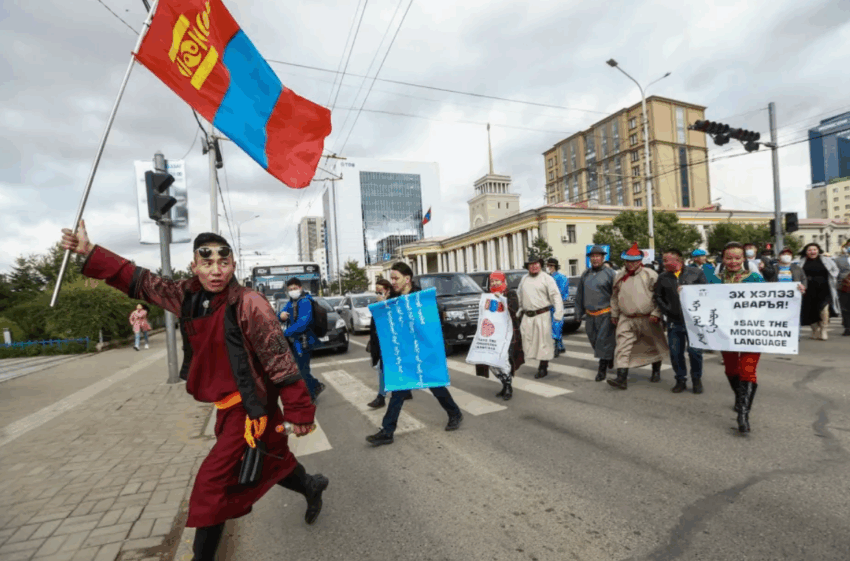
Under Chinese President Xi Jinping, however, that once-secure status has become increasingly precarious. China has reversed long-standing policies that allowed ethnic minority children to be educated in their own language, forcing Mongol children into Chinese language-only education. That prompted huge protests in Inner Mongolia in 2020, which were met with wider cultural and religious crackdowns.
Meanwhile, the CCP’s adoption of the term “northern frontier culture” is widely seen by Mongols as an attempt to erase their culture and identity. Mongol officials have been targeted in recent CCP purges, and Inner Mongolian institutions—including newspapers, publishing houses, temples, and universities—are dealing with tough new political regulations.
Mongolians across the border are watching this shift with growing concern. Though the Mongolian government has generally avoided direct confrontation with Beijing, it has quietly sought U.S. backing to balance against China and Russia.
However, as Mongolia’s chaotic political landscape evolves—and as troubling stories emerge from Mongols in China—it’s possible that anti-Chinese populism could become a more powerful political force.