
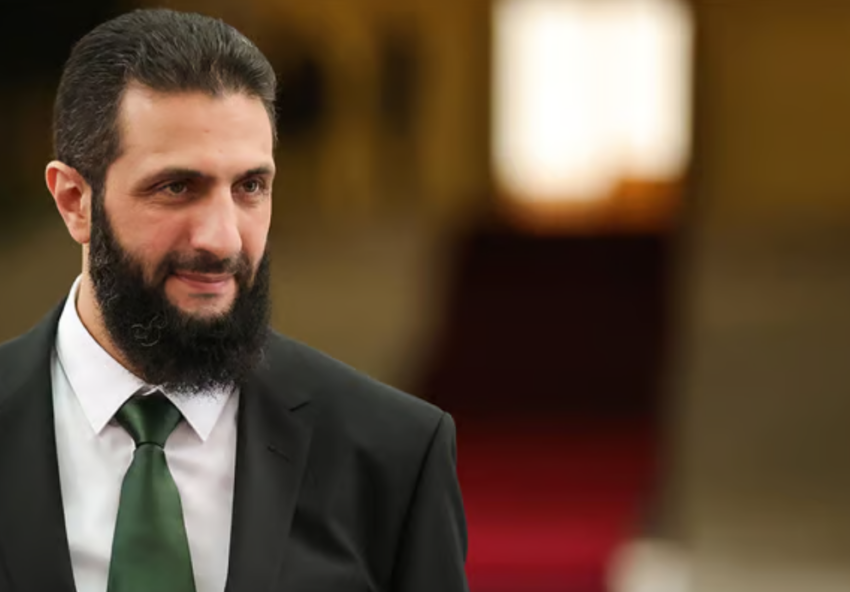
The meeting between Syria’s interim President Ahmad al-Sharaa and President Trump in Washington on Monday culminates the country’s pro-West realignment since the collapse of the Assad regime last December.
Publicado en The Soufan Center, el 10 de noviembre de 2025
- Sharaa is expected to formally join the U.S.-led, 88-nation anti-Islamic State coalition, paving the way for a significant U.S. military drawdown from Syria.
- Sharaa has reportedly agreed to allow some U.S. forces to use an airbase near Damascus to promote Israel-Syria deconfliction and eventual reconciliation.
- The U.S., its allies, and the UN are lifting sanctions on Syria to promote its transition and reconstruction, downplaying concerns over the radical Islamist roots of Sharaa and his associates.
Syria’s interim President Ahmad al-Sharaa will meet with President Trump at the White House today—the first ever official visit by a Syrian head of state—affirming the dramatic domestic and foreign policy transformation Syria has undergone since the forces of Sharaa’s Hayat Tahrir al-Sham (HTS) Islamist movement toppled Bashar al-Assad’s 24-year rule. To the geostrategic benefit of Israel as well as the U.S., the HTS takeover sharply reduced the influence, in Syria and regionwide, of Russia and Iran. Their forces and subordinate militias had helped Assad against his armed opposition since a 2011 nationwide uprising. Sharaa visited Moscow in October and welcomed Tehran’s diplomatic outreach. Still, his meetings with Trump and his subsequent policy decisions demonstrate Damascus’s intent to realign Syria with the U.S. and the West, more broadly. Because of Sharaa’s initial meeting with Trump in Riyadh in May, the U.S. has begun to remove the many overlapping sanctions imposed on Syria since it was placed on the U.S. “terrorism list” (list of state sponsors of terrorism) in 1979.
Although some Trump officials and U.S. allies assess that HTS’s past affiliations and ideology require caution, considering the group’s jihadist past, U.S. officials estimate that establishing multifaceted strategic, political, and economic relations with the new Syrian leadership can transform a region whose instability has prompted decades of repeated – and often costly – U.S. armed intervention. Another key beneficiary of Syria’s transition has been Türkiye, which was instrumental in Sharaa’s ouster of the Assad regime. But, Trump’s team assesses that Ankara, which is a member of NATO, can be a useful partner for stabilizing and reconstructing Syria, rather than necessarily a strategic competitor for influence there. Washington and Ankara are aligned in seeking to prevent Tehran and Moscow from regaining significant influence in Syria.
Whereas Sharaa’s most immediate needs are economic, the agenda for the Sharaa visit to Washington will focus primarily on defense and security matters. Tom Barrack, the U.S. Special Envoy to Syria and Ambassador to Türkiye, told reporters on the sidelines of the Manama Dialogue Conference in Bahrain last week that Sharaa is expected to sign a document on Monday formally adding Syria to the 88-nation, U.S.-led coalition against the Islamic State (ISIS). The terrorist group has taken advantage of the political transition in Syria to regroup and increase its attacks on Damascus’ forces.
Sharaa’s integration into the anti-ISIS coalition will represent an advance in the Trump team’s plan to transition the anti-ISIS mission to Damascus slowly. Doing so will enable Washington to reduce the U.S. troop presence to nearly 2,000. From 2017 until it took power in Damascus in late 2024, HTS conducted dozens of counterterrorism operations against ISIS. Since Assad’s fall, the U.S. has been providing Syrian forces with intelligence and has conducted at least eight joint anti-ISIS missions with them in government-controlled areas, according to Aaron Zelin, an expert at the Washington Institute for Near East Policy. Government forces began an anti-ISIS sweep coinciding with Sharaa’s arrival in the U.S. on Saturday.
But Syria’s military capacity is limited because its forces lack discipline and organization, remaining centered on militia-like structures. In addition, some factions within the military—including thousands of foreign fighters—continue to adhere to jihadist beliefs and might not be committed to fighting ISIS. A major impediment to transferring the anti-ISIS mission to Damascus includes the slow progress of U.S.-mediated talks to integrate the Kurdish-dominated Syrian Democratic Forces (SDF), which has been Washington’s leading anti-ISIS partner, into the Syrian military. Syria’s Kurds want to exercise significant autonomy in the new Syria, as do other minority communities such as the Druze and the Alawites, who were the backbone of Assad’s regime. But minority communities face roadblocks from Syrian leaders who insist on unitary, centralized authority.
Sharaa’s decision to join the anti-ISIS coalition represents an initial step in what the Trump team hopes will become a broader integration of Syria into a U.S.-led strategic architecture for the region. Trump envisions that a broad U.S.-led coalition of Israel and Arab and Muslim states could bring stability to the region indefinitely, ensuring that Iran and its Axis of Resistance partners – or outside powers Russia and China – cannot play the role of “spoiler” to undermine regional peace. Transitioning the region from recurring war to stable peace underpins the Trump team’s commitment to expanding the 2020 Abraham Accords pacts under which several Arab states normalized relations with Israel. Last week, Kazakhstan, a Muslim state that was part of the Soviet Union, became the first country to join the Accords in Trump’s second term.
Trump anticipates that Sharaa’s visit to Washington might eventually help him bring Syria into the Accords during his term. Although Syria’s entry into the Accords might be a long way off, Trump’s team has, as an initial step, sought to mediate an Israel-Syria security accord that would end the post-Assad Israeli attacks on Syrian military infrastructure and security forces. Israel has conducted the strikes in order to keep Syria strategically weak. For the purposes of the initial Israel-Syria security agreement, Damascus insists that Israel be required to withdraw to the Golan Heights disengagement lines held at the time Assad fell. It is unclear whether the U.S.-brokered discussions, thus far, have included any discussion of the ultimate disposition of the Golan Heights, which Israel occupied in the 1967 war and later annexed but remains internationally recognized Syrian land. Sources have reported that the Sharaa government might soften the Assad-era insistence that establishing diplomatic relations with Israel be contingent on the return of the Golan Heights to Syrian sovereignty. A resolution of all Israel-Syria territorial and security disputes held over from the numerous Arab-Israeli wars since 1948 and 54 years of Assad family rule might fulfill Damascus’s conditions for joining the Abraham Accords.
Sharaa sees closer strategic relations with the Trump team as a means of perhaps extracting the Israeli concessions Damascus seeks. In early November, Reuters reported that Damascus would allow the U.S. to establish a military presence at an airbase near Damascus. The mission of U.S. forces there will be unrelated to combating ISIS, but instead focus on monitoring an Israel-Syria security pact and on performing humanitarian operations. The base sits at the gateway to parts of southern Syria that are expected to make up a demilitarized zone separating Israeli and Syrian forces – suggesting Sharaa expects Washington to hold Israeli Prime Minister Benjamin Netanyahu accountable for any violations of a Syria-Israel security agreement. It is not clear when U.S. military personnel might deploy to the base. Still, sources said the move was discussed during Commander of the U.S. Central Command (CENTCOM) Admiral Brad Cooper’s September 12 trip to Damascus. Sharaa’s willingness to host U.S. forces at the base is, furthermore, a clear indication of the extent to which Syria has realigned strategically with the U.S. since Assad’s departure. As stark evidence of Syria’s repositioning, regional media noted the Syrian Foreign Ministry’s release Saturday of an undated but recent video showing Sharaa playing basketball with Cooper.
Economic and sanctions relief issues will also no doubt be on the agenda for the Trump-Sharaa meeting. Achieving comprehensive sanctions relief essential to the country’s reconstruction and its ability to fund its government and military operations is a key Sharaa goal. Trump’s team sought to lay the groundwork for Sharaa’s visit by demonstrating a commitment to fulfill Trump’s pledge to lift sanctions on Syria and the new leadership. Trump has already lifted most of the Syria sanctions he can lift on his own. Trump also has pressed Congress to repeal one key Syria sanctions law, the Caesar Civilian Protection Act, and Congress has begun acting on that request. Repealing that law would open U.S. and international firms to conducting transactions with key sectors of Syria’s economy that have significant state ownership, such as energy, construction, aviation, and others.
In advance of the White House meeting, U.S. officials also moved urgently to demonstrate that Sharaa and his top aides are no longer tarnished by their past membership in radical militant organizations. On Thursday, the UN Security Council adopted a U.S.-drafted resolution to remove the UN designation of Sharaa and Interior Minister Anas Hasan Khattab as terrorist leaders. On Friday, the U.S. delisted the two as “Specially Designated Global Terrorists” (SDGTs). A State Department announcement asserted the delisting was justified by Sharaa and Khattab’s actions to locate Americans missing in Syria; fulfill commitments on countering terrorism and narcotics; eliminate remnants of chemical weapons; promote regional security and stability; and build an inclusive, Syrian-and Syrian-owned political process. The United Kingdom followed suit, and the European Union is expected to take similar action in the coming days. Both men had formerly been subject to financial sanctions targeted at the Islamic State and al-Qaeda. Last December, days after the Assad regime vacated Damascus, U.S. officials terminated a $10 million offer for Sharaa’s arrest.