A win for Herbert Kickl, a would-be Viktor Orban
Publicado en The Economist, el 29 de septiembre de 2024
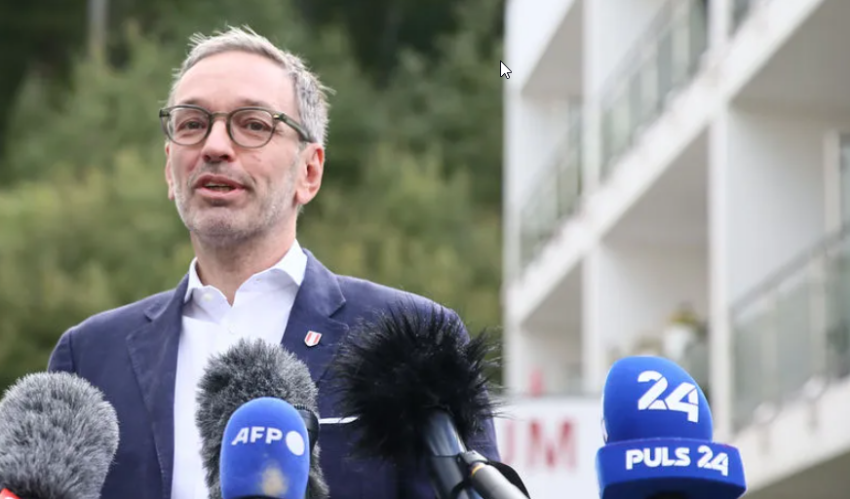
TWO DECADES ago it would have shocked the conscience of Europe. This time, it was generally expected. As forecast in the polls, a hard-right populist party came first in Austria’s parliamentary elections on September 29th for the first time in the country’s post-war history. The anti-immigrant Freedom Party (FPÖ), whose leader, Herbert Kickl, says he wants to imitate Hungary’s Viktor Orban, received 29% of the votes, according to initial exit polls—well above the 16% it got at the previous election in 2019. The governing centre-right People’s Party (ÖVP) got 26%, followed by the Social Democrats (SPÖ) with 20%, their worst result ever. The liberal NEOS party and the Greens each got about 9%, comfortably above the 4% threshold to enter parliament.
It is now up to Alexander van der Bellen, Austria’s president, to give one of the parties the chance to form a government. It may take him weeks to decide: Mr van der Bellen, who hails from the Greens, faces a tough task. The FPÖ’s only potential coalition partner is the ÖVP. But Karl Nehammer, the ÖVP’s leader and the chancellor, says he will reject any government with Mr Kickl in it. On the other hand, letting Mr Nehammer try to form another government despite finishing second risks infuriating the FPÖ’s voters and legitimating populist claims of anti-democratic deep-state bias.
Nonetheless, “the chances of Karl Nehammer remaining federal chancellor are good,” says Peter Filzmaier, a political scientist at both Krems and Graz universities. Mr Nehammer could form a three-party coalition with the SPÖ and either the Greens or NEOS. Had the ÖVP come first, Mr Nehammer could have formed a “black-blue” coalition with the FPÖ as junior partner, as it did in 2000, 2003 and 2017. The problem is that the FPÖ’s first-place finish makes it harder for that party to accept junior status or to sideline Mr Kickl. (Mr Nehammer’s objections are based in part on Mr Kickl’s disastrous tenure as interior minister in 2017-19, which led foreign governments to refuse to share sensitive intelligence data with Austria.) Because the FPÖ’s strong showing makes it more threatening to the ÖVP, it paradoxically renders it less likely to participate in government.
In recent weeks observers thought that massive floods in Austria and across central Europe might hurt the FPÖ, which denies the seriousness of climate change. They seem to have been mistaken. The FPÖ was in a jubilant mood. Christian Hafenecker, the party’s general secretary, in effect said that Mr Nehammer should resign after his party’s poor showing, and that he expects the FPÖ to lead the talks on forming a government.
Even so, the more likely outcome is a three-way coalition led by Mr Nehammer and the ÖVP, including the SPÖ and one other party. It would probably be a fragile construction. Mr Nehammer does not get on with Andreas Babler, the unpopular leftist leader of the SPÖ. His preference for a third partner is the NEOS, whose economic policies are close to his own. Mr Babler prefers the Greens. The travails of Olaf Scholz’s three-way “traffic-light” coalition in Germany show how tricky a combo of three disparate parties is, in particular in challenging times.
It is not entirely impossible that the FPÖ might agree to playing second fiddle in a black-blue government with the ÖVP. The parties co-operate elsewhere: three Austrian Länder (Lower Austria, Salzburg and Upper Austria) include the FPÖ and ÖVP in their regional governments. But every federal government involving the FPÖ has ended up mired in scandal. The most recent collapsed in 2019 after Heinz-Christian Strache, then the FPÖ’s leader, was caught on camera promising government contracts to a woman impersonating the niece of a Russian oligarch.
Even if the FPÖ and ÖVP end up in alliance under a compromise chancellor other than Mr Kickl, the FPÖ’s leader would continue to pull the strings. Some European hard-right leaders, such as Italy’s Giorgia Meloni, have proven pragmatic once in power, but the FPÖ boss seems unlikely to be among them. His self-proclaimed role model is Mr Orban, the Hungarian leader who has turned his country into a quasi-autocracy since coming to power in 2010. He is anti-immigration, anti-Islam and strongly Eurosceptic, and refuses to condemn Russia’s invasion of Ukraine. His electoral programme, entitled “Fortress Austria”, calls for ending political asylum entirely, which would breach European Union rules. The way the party presents itself has become more mainstream, but it was founded in the 1950s by former Nazis and has a habit of showing its roots. On September 28th, the day before the election, Der Standard, an Austrian daily, published a video showing party members at the funeral of an FPÖ politician singing “Wenn alle untreu werden” (“If all become unfaithful”), an anthem popular with the SS.
Mr Kickl himself frequently plays with Nazi allusions. He says he wants to be the next Volkskanzler (people’s chancellor), a term associated with Hitler (who was Austrian by birth and considered the country part of Germany). The slogan on his campaign posters, “Thy will be done”, is thought by some to invoke the previous line in the Lord’s Prayer: “Thy kingdom come”—in German, Dein Reich komme, a dog-whistle reference to the Third Reich. He has praised the Identitarian movement, a group of European outfits with philosophies resembling America’s nativist national conservatives.
Nonetheless, Mr Kickl is a cerebral strategist known for playing the long game. Should the ÖVP refuse to govern with the FPÖ, he might not be averse to remaining in opposition and fanning the flames of political polarisation. He will have another chance at the next parliamentary election in 2029, when he will still only be 60 years old.
If the FPÖ does end up leading a government, it will make Austria the latest in a growing cluster of European states where the populist hard right is in government or plays a crucial supporting role. These include Hungary, Italy, the Netherlands and Sweden (though Poland left the list last year). In 2000, when the FPÖ first entered a coalition with the ÖVP, other members of the European Union were so outraged that they attempted a diplomatic boycott of the country. Those days are long gone.