
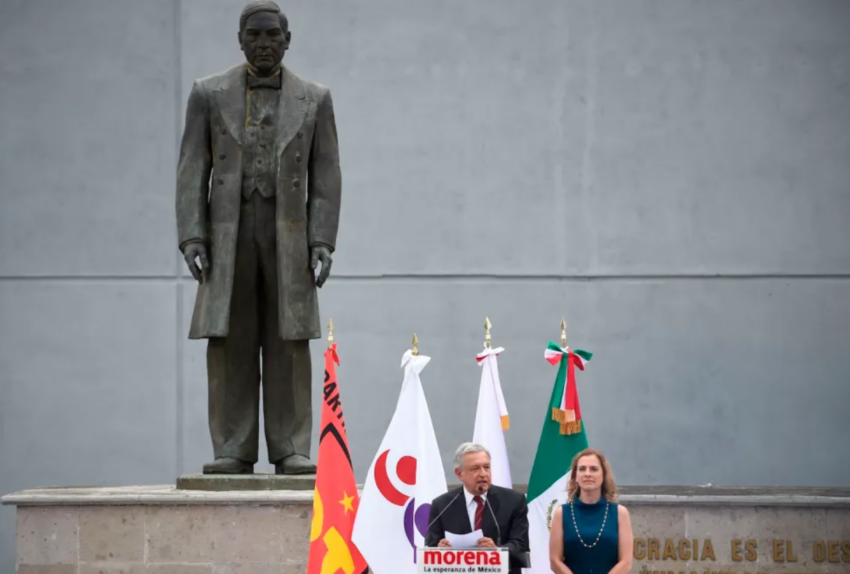
The outgoing Mexican president recast historical leader Benito Juárez’s foreign policy for the modern world.
Publicado en Foreign Policy, el 26 de septiembre de 2024
By Tom Long, a professor in international relations at the University of Warwick and an affiliated professor at the Center for Research and Teaching in Economics in Mexico City, and Carsten-Andreas Schulz, an assistant professor in international relations at Cambridge University.
Mexican President Andrés Manuel López Obrador is preparing to step down on Oct. 1 after six years in office. He leaves with soaring approval ratings and a handpicked successor who is poised to maintain his legacy. Although López Obrador’s tenure has been polarizing, both his detractors and supporters concede that he has transformed Mexico’s domestic political scene.
On matters of foreign policy, however, the conventional wisdom holds that López Obrador has been something of a nonentity. Critics suggest that he knows and cares little about the world beyond Mexico. The president rarely traveled abroad, and he routinely skipped important global summits. An initiative early in López Obrador’s term to raffle off his presidential airplane was both a denunciation of previous governments’ excesses and a signal that he planned to stay put.
Yet this isolationist reading of López Obrador’s tenure misses the mark. Instead, his foreign policy reveals a worldview reminiscent of former Mexican President Benito Juárez, who served from 1858 to 1872 as his country was nearly torn apart by a foreign invasion and civil war. Juárez’s blend of principled leadership and pragmatic diplomacy seemingly influenced López Obrador’s nationalist approach to international affairs.
In Mexico, Juárez occupies a stature akin to that of his U.S. contemporary Abraham Lincoln, revered for his integrity in times of national crisis. However, historians and international relations scholars have mostly overlooked Juárez’s global vision.
Juárez rose from humble beginnings as an orphan in rural Oaxaca, eventually becoming the first Indigenous president in the Americas. He led Mexico through profound transformation, guiding the country through divisions over colonial legacies and role of the Catholic clergy toward its consolidation as a liberal state—all while dealing with both a civil war and a foreign invasion.
In the early 1860s, then-French leader Napoleon III viewed the U.S. civil war as an opportunity to restore France’s imperial prestige while challenging the Monroe Doctrine, which asserted U.S. supremacy and declared the Western Hemisphere while closing it to European monarchical rule. A French intervention in Mexico culminated with the imposition of Habsburg Archduke Maximilian as emperor. Juárez’s leadership during the resistance against and defeat of this usurping became his defining moment. In Mexico today, he is said to have ushered in the country’s “second independence.”
López Obrador draws on this history. Visiting Juárez’s birthplace earlier this year, the president called Juárez his “reference and guide,” suggesting that he seeks inspiration if not counsel from his 19th-century predecessor. “Juárez is still among us,” López Obrador said at the time. Portraits of Juárez adorn the president’s private offices as well as the National Palace. Echoing the late leader’s rhetoric, López Obrador often uses the adjective “republican” to describe his policies.
López Obrador’s reverence of Juárez has been noted domestically, but observers rarely make the connection to his foreign policy—perhaps due to analysts’ dismissal of both men’s international visions. Despite his historical importance, Juárez is understood more as a political survivor than a visionary. But his worldview was nuanced and intricate.
Juárez and his coalition possessed a coherent internationalist worldview. Rejecting imperialism and monarchy as inherently illiberal, Juárez and his supporters argued for organizing world politics in accordance with what we now dub “republican internationalist” principles: popular sovereignty, equality of states, peaceful settlement of disputes, and a rejection of foreign intervention legitimated by “civilizing missions.” He prized the “fraternity” of other republics, which was reflected in his relations with the rest of Spanish America and his hope for more positive ties with the United States after Lincoln’s 1860 election.
In practice, Juárez’s principles were tempered by pragmatism. After all, his Mexican republic was broke and overmatched by Europe’s leading land power. Although they were briefly victorious against French expeditionary forces in Puebla on May 5, 1862, Juárez and his government were soon chased out of Mexico City by French reinforcements. The liberal government survived by trapsing across Mexico’s vast territory, becoming a republic with an itinerant capital.
Although Juárez’s opposition to France and its puppet emperor was unwavering, he struck deals to keep his ragtag government together. With Mexico’s conventional army outmatched, he fomented a guerrilla insurgency and cultivated respect from the United States, which had annexed half of Mexico 20 years before. As a result, Juárez gained U.S. support when Washington emerged from its own civil war.