
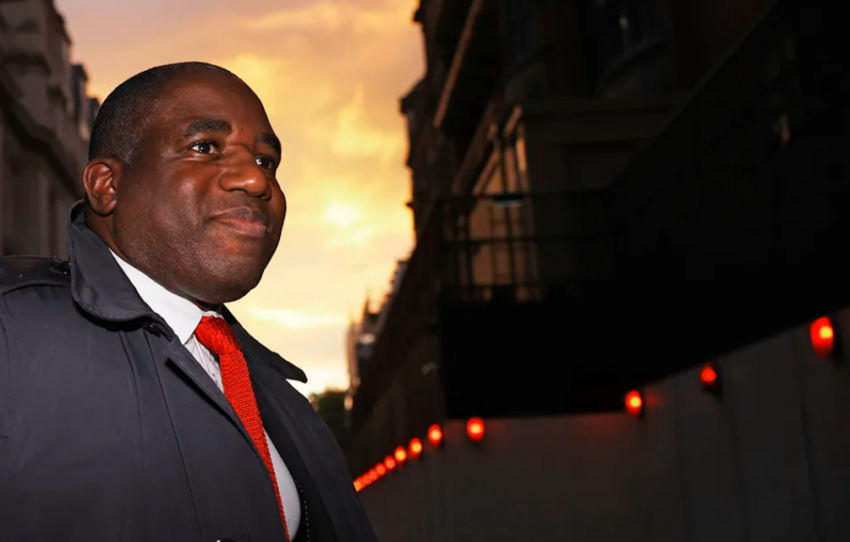
David Lammy is determined to stay on message—but he has always had strong opinions.
Publicado en Foreign Police, el 8 de julio de 2024
“We don’t have a lot of time, do we?” David Lammy says as I sit down next to him. “Sorry about that!” We’re meeting in a bistro near Parliament, and it is nearly empty. That’s no surprise; Britain’s general election is a couple of weeks away, and everyone has decamped to their part of the country to campaign.
This is why Lammy’s team could only offer me half an hour with the then-shadow foreign secretary. He was already a busy man, and now he’s about to get busier, following his official appointment as foreign secretary last Friday. The day before that, Labour pulled off one of the largest landslides in U.K. political history.
Under strict instructions from party leader Keir Starmer, Labour’s shadow frontbench—the spokespeople who, after the election, are poised to become secretaries of state—has had to remain relentlessly on message. Every interview revolves around delivering a few clear messages and little else. Every policy announcement has been run past a thousand focus groups. Every decision is calculated, and every intervention is as precise as it needs to be.
A sign that the Starmer doctrine really has worked is that, over the course of our half-hour together, Lammy, for once in his life, fails to say anything truly compelling. There’s a reason he apologized to me; the foreign secretary is a very interesting man, and for the last six weeks he has been doing his best to hide it.
Before I first interviewed him just over a year ago, I tried to read every interview he’d given until that point to get a sense of who he was. It nearly made me lose my mind. There are approximately 1 million interviews of Lammy.
Over his 24 years in Parliament, he has spoken to every publication about everything. He has charmed and infuriated interviewers, argued with them, laughed with them, changed their minds, and shouted at them.
But he was always interesting, often taking turns you wouldn’t have expected. A straight talker with strongly held opinions on countless issues, he was the person you’d go to if you had inches to fill in your paper and wanted some solid quotes.
“It’s a bit like when you are writing a book,” he told the Guardian back in 2017. “You can’t self-edit in the first draft. You have to say what you feel and what you see. … I am not self-editing.”
This is why Starmer’s decision to appoint him in a senior position felt eyebrow-raising. Could a temperate control freak really work with a man many had previously seen as a bit of a loose cannon? As it turns out, he could.
“I’ve always been my authentic self, and I continue to be that in politics,” Lammy tells me. “In the end, if we get over the line in the election, I carry the responsibility of a big office of state. The short leash is something that I’ve created—I’m part of the decision-making machine of the Labour Party that has created that short leash. I’m very happy to do that.”

Cherie Blair, wife of Prime Minister Tony Blair, watches as Lammy holds a baby in London on June 19, 2000, when he was campaigning as a Labour candidate in Tottenham. FIONA HANSON/PA IMAGES VIA GETTY IMAGES
Perhaps it shouldn’t be a surprise; as Lammy puts it himself, he is now in the third act of his political career. The first act began in 2000, when he became the member of Parliament for Tottenham, a long-term Labour stronghold in northern London. At the time, opponents had sought to paint him as a “slick, media-friendly candidate who will represent the interests of the Labour party leadership rather than the people of Tottenham.”
In a way, they weren’t wrong. Here was a confident young barrister and the first Black Briton to attend Harvard Law School. Elected at only 27, he got his first junior government job in 2002, under Prime Minister Tony Blair. That year, the Guardian called him “one of Westminster’s more glamorous MPs.”
Still, he was a more complex character than what was being portrayed.
“I came from a broken home. I was raised by a single mom—I was not some young whippersnapper, like a young Boris Johnson,” he told me last year. “A lot of my peers had spent time in prison, were struggling with mental health, had parents like mine who’d had periods of unemployment.