
The sight of armoured vehicles ramming the presidential palace will scare investors away
Publicado en The Economist, el 27 de junio de 2024
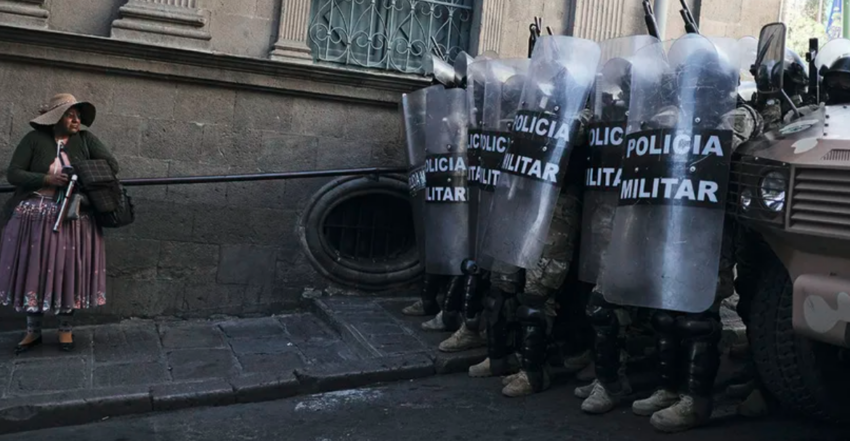
The soldiers and armoured vehicles that swarmed through La Paz, Bolivia’s capital, on June 26th had one destination: the presidential palace. After a small tank repeatedly rammed its doors, soldiers pushed inside. The leader of the uprising then revealed himself as Juan José Zúñiga, the commander of the armed forces until his sacking on June 25th. “There will be a new cabinet of ministers,” he told reporters. Politicians had to “stop destroying, stop impoverishing our country, stop humiliating our army”. The army was trying to install “a true democracy”. The army, he underscored, “did not lack balls”.
Nor, it seemed, did President Luis Arce. At one point he emerged to argue with the putschists face-to-face. Returning inside, he managed to hold a ceremony to appoint new heads of the armed forces, over the booming of tear gas being fired at pro-democracy protesters outside. It was an “atypical” day, he noted dryly, but swore “we will defeat any coup attempt.” He called on Bolivians to mobilise to defend democracy, but also to stay calm. The new top brass demanded all soldiers return to the barracks. Meanwhile one of Bolivia’s biggest unions announced a general strike in protest at the coup attempt. Condemnation of the attempted putsch poured in from leaders across the world.
Almost as suddenly as they had arrived, the soldiers left, replaced by crowds of civilians chanting in support of democracy. Mr Arce emerged onto the presidential balcony and used a megaphone to declare that “no one can take away the democracy that we have won at the polls and with the blood of the Bolivian people”. The apparent coup attempt had failed.
That is good news for a region that believed coups were largely consigned to history. But the uprising was prompted, at least in some way, by a profound political and economic crisis. Ahead of elections next year Mr Arce and Evo Morales, a former president, are vying for power. Tensions between the pair—both leftists and former colleagues—have paralysed the government, aggravated economic woes and, in turn, fuelled street protests. The sight of tanks ramming the presidential palace has succeeded only in making Bolivia appear more unstable and chaotic to businesses, investors and tourists.
The rolling political crisis began in 2019 when Mr Morales ran for an unconstitutional third term. He won, but after accusations of fraud and mass protests that caused 36 deaths the army asked him to resign. He did so, and left the country.
In 2020 Bolivia elected Mr Arce as president. He had been Mr Morales’s economy minister. But as the pandemic battered the country, the economy slumped. Mr Morales returned, saying he would run against Mr Arce in 2025. The president says this is unconstitutional (the constitutional court agrees). Meanwhile Mr Morales’s allies in Congress have made it almost impossible for Mr Arce to govern, blocking efforts to secure loans that would relieve pressure on the government purse, and scotching plans to bring in foreign investors to mine abundant reserves of lithium. Mr Arce calls this an “economic boycott” by his rival’s allies. Mr Morales has threatened to unleash unrest if he is stopped from running.
The uprising seemed momentarily to unite the two angry leftists. Mr Morales quickly denounced the attempted putsch and called for a mass mobilisation to protect democracy. It may have helped that General Zúñiga appeared to favour the political right.
Yet with soldiers back in their barracks the chances of a smooth resolution to the leftists’ dispute remain slim. The army’s escapade may have deepened it. General Zúñiga was arrested on the evening of his failed coup. He may have been attempting to seize power, using the political and economic crisis as justification; he was sacked after saying he would not let Mr Morales be president again on national television. But as he was taken away he accused Mr Arce of asking him to stage an uprising “to raise [the president’s] popularity”. Even if false, the accusations may fuel more chaos.
Meanwhile ordinary Bolivians continue to struggle. The country is desperately short of dollars. Fuel, which is largely imported, is scarce. The official exchange rate between the boliviano and the dollar has all but collapsed. The black-market rate is some 50% above the official one. Bolivian merchants have flooded over the border into Brazil and Peru desperately trying to buy dollars at a steep premium.
The government spends some $2bn a year to import subsidised fuel, nearly bankrupting it. Natural-gas extraction, once a source of strength, is fading fast in part due to lack of investment by the state-owned hydrocarbons company. By 2030 the country may be a net importer of natural gas. In February Fitch downgraded the country’s debt from junk to even grimier junk. Now deep divisions in the army must be added to the wider political crisis.