
Can it fight Hamas and Hizbullah simultaneously?
Publicado en The Economist, el 17 de junio de 2024
Red banners that hang across bridges above the main roads leading north in Israel contain one word: “Abandoned”. It is a word that is repeated in almost every conversation with the few residents remaining in the near-deserted towns and villages near the border, which have been under fire for eight months from Hizbullah, the Iran-backed movement that controls Lebanon. It is also an accusation levelled at the government of Binyamin Netanyahu, Israel’s prime minister, which has failed to come up with a solution to the unrelenting barrage of missiles and explosive drones that Hizbullah began firing on October 8th, the day after Hamas launched a surprise attack on Israel’s southern communities. Hassan Nasrallah, the leader of Hizbullah, recently vowed to continue the attacks, insisting that his group is acting as a “support front” for Hamas.
“We’re like ducks in Nasrallah’s shooting-range,” says Gidi Sayada, a winemaker from Safsufa, a village that has not been evacuated. “My daughters have been sleeping in the safe-room of our house for the past eight months.” This undeclared war in the north has largely kept to an unwritten set of rules. Hizbullah has shelled mainly targets close by the border and military bases. Israel has responded with targeted strikes on Hizbullah operatives, in some cases deep inside Lebanon.
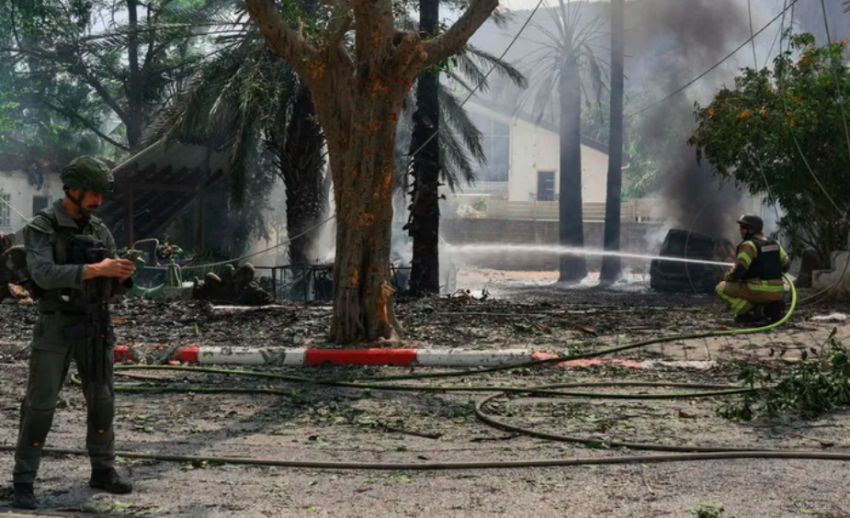
Though neither side has unleashed anything near their full arsenal, the cross-border fire has increased since mid-May and last week reached its most intense level since the start of the war. Using data from a nasa satellite system and a machine-learning algorithm to track war-related fires, The Economist has been able to count the number of strikes occurring on both sides of the border (see map and chart). In the week ending on June 16th there were 640 such strikes, 254 of them on June 13th alone. The missiles and drones targeted a wider area in Israel, including the city of Safed, which has not been evacuated and where Hizbullah has been trying to hit military installations. These include the Northern Command of the Israel Defence Forces (idf).

Though a measure of calm has again returned in the past few days, perhaps due to the start of Eid al-Adha, a Muslim holiday, the fighting has upended lives in both Lebanon and Israel. In the first days of the war Israel evacuated civilians living within 2km of the border. Some 60,000 have yet to return to their homes. Among the few who remain are a handful of farmers, who stayed on to work their fields and to tend to the livestock. In Kiryat Shmona, the largest border town—previously home to about 22,000 people—only about 3,000 remain, mostly pensioners. Across the border in southern Lebanon more than 90,000 people have also fled from their homes.
In numerical terms, Israel has caused more damage to Hizbullah, killing over 300 of its operatives during this period, while 28 people have been killed in Israel. On June 12th, an Israeli air strike killed Taleb Sami Abdallah, a senior Hizbullah member in command of its forces in southern Lebanon. But these strikes have done little to alleviate the desperation among Israelis living in the north.

The continuing bombardment and evacuation of civilians in Israel are leading to increasing calls for Mr Netanyahu’s government to act more forcefully against Hizbullah. “It’s hell here right now so we may as well have an all-out war with Lebanon,” says Danielle Levy, an exhausted police volunteer from Safed. This is a sentiment widely heard in the region. The political pressure on Mr Netanyahu is particularly intense because many of the civilians most affected are among his core supporters. In Kiryat Shmona, three-quarters of the electorate voted for Likud, Mr Netanyahu’s party, or its allies in the previous election, but it is now impossible to hear a good word said about the prime minister. “We’re totally abandoned and the government are a bunch of muppets,” says Shimon Maimon, a retired painter. “I’ve voted Likud all my life, but I don’t understand why Netanyahu isn’t doing anything.” The prime minister is also under pressure from his far-right coalition partners to escalate. Bezalel Smotrich, the finance minister and leader of the nationalist Religious Zionism party, has demanded that Israel “occupy southern Lebanon” if Hizbullah continues firing. For now, though, the leaders on both sides of the border are not inclined towards letting the conflict explode into all-out war.
Still, with the fighting in Gaza being scaled down, some idf units have been redeployed to the north where they are preparing for a ground offensive against Hizbullah. In such a scenario Israel would seek to occupy a “security zone” that would put northern communities out of range of some of Hizbullah’s missiles. But a ground incursion would almost certainly trigger a fiercer response from Hizbullah, which would probably launch long-range missiles capable of hitting targets deep within Israel. To prevent this, the idf would need to carry out pre-emptive strikes on the missile-launchers and Hizbullah’s headquarters, many of which are based in civilian areas. Heavy civilian casualties in both Lebanon and Israel are a certainty in such a war.
Israel’s American allies have been urging it to hold fire. Amos Hochstein, a senior adviser to President Joe Biden, has shuttled back and forth to the region in an attempt to craft a ceasefire between Israel and Hizbullah. Mr Netanyahu seems open to this idea, though he is less keen on agreeing to stop fighting in Gaza. In a defiant statement on June 15th he said that “there is no alternative to victory” and that Israel must continue fighting Hamas.
Israeli generals insist that, if necessary, the idf can fight on two fronts. But they admit that doing so would drastically stretch the army, which relies on hundreds of thousands of reservists, many of whom have already spent long months of fighting in Gaza. “To take over southern Lebanon we’ll need a lot more troops, but meanwhile most of the units are in or around Gaza,” says one reserve commander who has been on exercises preparing for such an operation. “The plans feel incomplete.”
The idf would like to pause the war against Hamas, preferably through a ceasefire that would also secure the release of the 120 Israeli hostages still in Gaza. But a truce in Gaza would probably prompt Hizbullah also to stop firing. That would leave Israel’s leaders with the dilemma of whether to start a new war to push the group away from the border or to allow it to remain in a position to threaten Israeli communities. In 2006, after a previous war between Israel and Hizbullah, the un Security Council passed resolution 1701, which ordered the militia to withdraw its weapons and fighters from southern Lebanon.
The consensus within Israel’s security establishment is that war with Hizbullah is inevitable. But increasingly the view among the generals is that it should not take place soon. Major General Yitzhak Gershon, who served recently as the second-in-command of the northern front, published an article on June 13th saying that although he had been in favour of attacking Hizbullah immediately on October 7th, he had since changed his mind.
“Israel should be headed to a diplomatic arrangement, not war, at this time,” he wrote, adding that its strategy over the past eight months had amounted to a “mad run with the head into a wall”. The country, he argued, needs a ceasefire in both Gaza and Lebanon to take stock, elect a new government and regroup. “After what happened with Hamas on October 7th, we’ve learned that we can’t allow our enemies to hold destructive capabilities on our borders,” says one veteran intelligence analyst. “But we should choose the timing [of any war] and not be dragged into it by Nasrallah.”