
Anger, tears and recriminations
Publicado en The Economist, el 14 de mayo de 2024
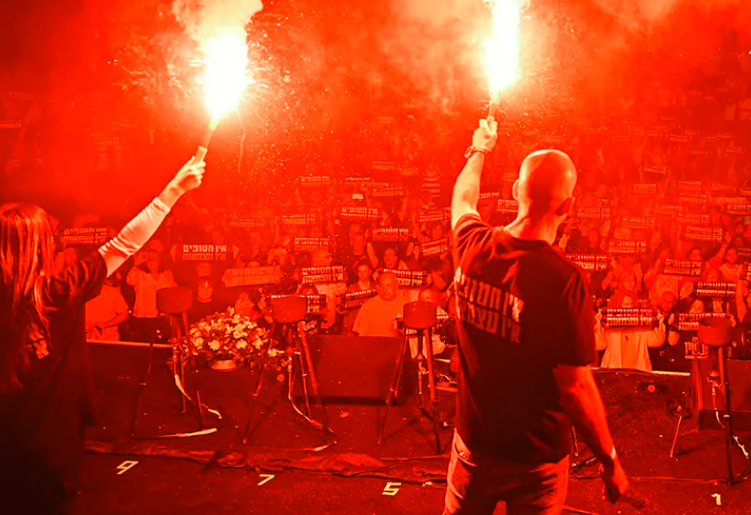
The torch-lighting which traditionally opens Israel’s Independence Day was broadcast on the evening of May 13th as usual. But instead of being televised live as usual, the event was pre-recorded. The government said this was because of the solemnity of holding the ceremony while the nation is at war. The real reason, however, was the politicians’ fear that it would be disrupted by protesters, furious with their failings in handling the war. In a breach of protocol, some broadcasters simultaneously screened an alternative Independence Day ceremony organised by the families of hostages held in Gaza, protesting against the government (pictured).
As Israel celebrated the 75th anniversary of its independence a year ago, it seemed to many, including this newspaper, that the most immediate threats to its prosperity, stability and security came from within. A new government, in which far-right and religious nationalist parties held sway, had launched a radical constitutional overhaul, aimed at dramatically weakening the independent Supreme Court. The proposed reforms brought hundreds of thousands of Israelis out on the streets in bitter protests against what they saw as the dangerous erosion of their country’s democratic foundations.
It was a clash between two Israels: a secular and, at least in its own eyes, liberal state still aligned with the ethos of Israel’s socialist-Zionist founders; and the new Israel of the ruling right-wing Likud party and its ultra-Orthodox partners. Those two visions of the country’s identity looked increasingly incompatible. Constitutional crisis loomed and Isaac Herzog, Israel’s president, warned of civil war.
Meanwhile long-standing external threats—the ongoing conflict with the stateless Palestinians and an increasingly aggressive Iran—seemed manageable. The salience of Israel’s festering occupation of the Palestinians in the West Bank and blockade of Gaza had faded regionally and internationally. Israel had formalised diplomatic relations with five Arab nations and a breakthrough with Saudi Arabia seemed to be just around the corner. Joining together to confront the influence of Iran, a shared rival, that took precedence over resolving the plight of the Palestinians.
Fast-forward 12 months to the 76th anniversary and the dangers beyond Israel’s borders loom large. Israel is stuck in a disastrous war in Gaza, triggered by the atrocities inflicted by Hamas, the Palestinian Islamist movement, last October. The conflict has killed over 30,000 Palestinians, including Hamas fighters. That has triggered a wave of legitimate protest against Israel, legal action accusing it of breaking international law and a global upsurge in antisemitic activity. President Joe Biden has begun to restrict the supply of weapons to Israel in order to dissuade it from a full-scale invasion of Rafah, the last stronghold of Hamas, and to satisfy his critics at home.
Beyond Gaza the picture is grim. Hizbullah, the Iranian-backed Lebanese militia, has launched its own war of attrition, forcing tens of thousands of people on both sides of Israel’s northern border to abandon their homes. The wider region has become more threatening. The Houthis in Yemen are targeting shipping in the Red Sea, as part of what they claim is a siege on Israel. On April 13th Iran launched a direct attack on Israeli soil in retaliation for the assassination of one of its most senior generals at its diplomatic compound in Damascus. A coalition of western and Arab militaries helped Israel fend off the attack, averting open war, at least for now. But as the death toll mounts in Gaza, ties with Israel’s Arab neighbours are fraying. The relationship with Egypt, which also borders Gaza and is worried about the conflict spilling over, looks particularly fragile. Saudi Arabia’s crown prince and de facto ruler, Muhammad bin Salman, is apparently still open to “normalisation” with Israel, but wants to see a ceasefire in Gaza and a revival of the moribund peace process with the Palestinians first.
It couldn’t last
At first Israel responded to the Hamas attack with a display of unity. The trauma of the massacre of nearly 1,200 people on October 7th and the kidnapping of over 250 into Gaza blotted out the divisions. Some 300,000 reservist soldiers, including many who before the war had been threatening to suspend their service in protest at the proposed constitutional changes, rushed to their units. Israelis seemed to set aside their differences; secular and religious volunteers came together to help families who had been displaced by the fighting. Support for the war and for Israel’s armed forces was strong.
But as the conflict has continued, the splits within the country have resurfaced. Support for the invasion of Gaza has not translated into support for the government. The disputes over the judicial system have been replaced by anger at the politicians who have catastrophically mishandled the war. Among the sites Hamas attacked on October 7th were kibbutzim and a music festival, both bastions of the secular, liberal Israel so at odds with the government of Binyamin Netanyahu. Kibbutz survivors have refused to meet the prime minister, who has infuriated many Israelis by failing to take responsibility for the intelligence and defence failures that preceded October 7th.
Resentments have deepened as Israelis have argued over whether they shouldered an equal burden in the war. The fighting has sharpened secular Israelis’ anger at the ultra-Orthodox, who represent 13% of Israelis and whose young men have long been exempted from military service. The exemption has been ruled unconstitutional by the Supreme Court, to the anger of ultra-Orthodox parties who are a key element in Mr Netanyahu’s coalition.
On Memorial Day, which falls the day before Israelis celebrate their independence, the country remembers fallen soldiers and victims of terror attacks. This year government ministers were heckled at services of remembrance. Relatives of soldiers who have been killed in the war in Gaza walked out of Mr Netanyahu’s speech at the national cemetery. In his address Mr Herzog implored Israelis to allow “the tear in the heart of the people” to “heal the tear in the nation”. A year ago the president tried to use his position, above politics, to find a compromise over constitutional reform. He failed to reconcile Israel’s warring tribes then and seems likely to fail now.
The divisions between Israelis have shaped the course of the war. Mr Netanyahu has refused to formulate a strategy to end the war beyond the vague goals of “destroying Hamas” and “total victory” because he remains so dependent on his far-right coalition partners. They make no attempt to hide their desire to permanently re-occupy Gaza and rebuild the Jewish settlements that Israel dismantled there in 2005.
An overwhelming majority of Israelis supported the war in its early months. That is changing. According to one recent survey 62% of the country now thinks a temporary ceasefire agreement to release the surviving hostages in Gaza should take priority over another military push into Rafah. But Mr Netanyahu is reluctant. The hardliners in his cabinet are threatening to bring down the government if the war is paused.
Those who protested against Mr Netanyahu’s judicial reforms are back on the streets but they have struggled to find a unified message. Some call for the release of the hostages, whatever the price. Others are demanding an end to the war. Many are simply clamouring for Mr Netanyahu to go. Meanwhile the government’s supporters have organised their own pressure groups of families of hostages and fallen soldiers who demand that Israel continue pummelling Gaza.
The Biden administration and its partners in the region have offered Israel a way out of the war with the vision of a “revitalised” Palestinian Authority replacing Hamas in Gaza and the building of an American-backed regional alliance against Iran and its proxies. It would be far from simple but would be preferable to what looks like an unwinnable war.
And yet the splits within Israel are making it nearly impossible for the country to follow such a path. It is blocked by the combination of a deeply traumatised and divided population, an electoral system that gives disproportionate power to small radical parties and an unpopular leader fighting for his political survival above all else. A year ago, those on the right, including Mr Netanyahu, thought Israel could survive its domestic turmoil in part because it no longer faced the external threats of the past. Today, it is clear that even at the height of war, the greatest threats to Israel remain those within its own borders.