
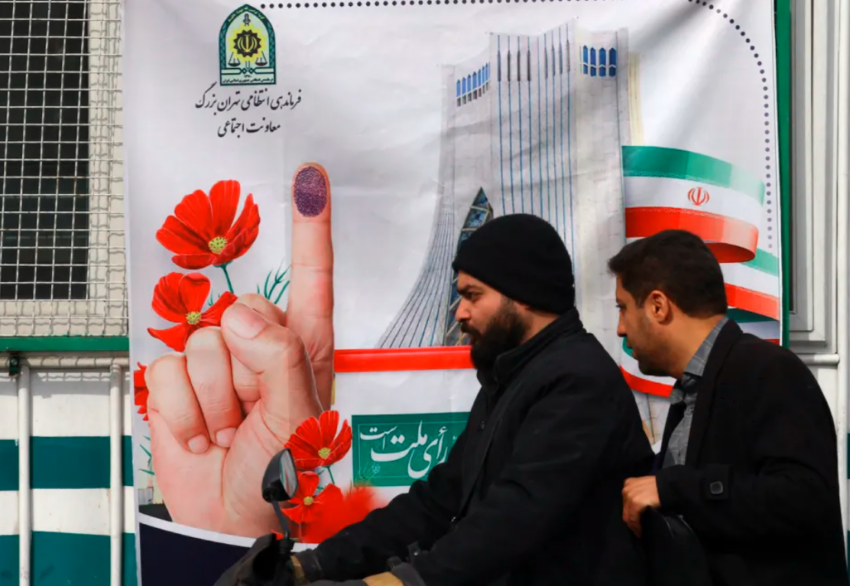
In last week’s parliamentary election, the Iranian political spectrum shifted to include a new group of outsiders.
Por Sina Toossi, publicado en Foreign Policy, el 7 de marzo de 2024
On March 1, Iran held elections for its parliament and the Assembly of Experts, the influential body responsible for overseeing and appointing the supreme leader. The Iranian public showed little interest—there was a historically low turnout of 41 percent, with only 25 million out of more than 61 million eligible voters participating—but Iran’s political landscape nevertheless experienced an important shift.
The elections, it’s important to note, were neither free nor fair. They were marked by the disqualification of many prominent figures by the Guardian Council, which vets candidates for their loyalty to the Islamic Republic. Among those barred from running for the Assembly of Experts were moderate former President Hassan Rouhani and former Intelligence Ministry chief Mahmoud Alavi, both current members of the assembly. The main political organization of reformists and other critics of the system either did not participate or advocated for a boycott. To the extent there was diversity in the elections, it was the product of new competition among Iran’s conservative factions.
There are no formal political parties in Iran, but influential movements, groups, and leaders publish lists of their preferred candidates. In Tehran, for example, the city’s 30 parliamentary seats—the most influential in the country—were contested by a collection of candidates appearing on lists from various conservative factions. (The lone moderate list—called the Voice of the Nation and led by Ali Motahari, a dissenting conservative voice—failed to secure any seats due to the low voter turnout and the relative obscurity of its candidates.)
The showdown between conservatives in the capital city saw the rise of some candidates who were newcomers to electoral politics and did not toe the mainstream conservative line. They challenged the establishment conservative list, known by the acronym SHANA, which was led by Mohammad Bagher Qalibaf, the speaker of the parliament and a former Islamic Revolutionary Guard Corps (IRGC) commander with a long political career that includes running for president and serving as Tehran’s mayor.
The nonestablishment conservative lists were predominantly composed of hard-line figures. Unlike the reformists and moderate conservatives, who have shown some willingness to adapt and compromise on certain issues, they seek a rigid and purist version of Islamic law, reject any reforms that might threaten their power or ideology, and are more skeptical or opposed to engagement with Western powers. For instance, the hard-line winners in Tehran this election were fervent opponents of the 2015 nuclear deal, unlike the current speaker Ghalibaf, who was more supportive and pragmatic about the talks.
The hard-line lists included Amana, led by politician Hamid Rasaee; the United Front, headed by Manouchehr Mottaki, the former foreign minister under President Mahmoud Ahmadinejad; and Morning of Iran, aligned with Ali Akbar Raefipour, a controversial thought leader who has propagated antisemitic conspiracy theories, and Saeed Mohammad, the former head of the IRGC’s engineering arm.
While some of the lists had common candidates, the most establishment one, SHANA, suffered significant losses, and the more hard-line and nonmainstream groups, namely Morning of Iran and Amana, made gains. The triumvirate of top vote-getters in Tehran comprised of hard-line clerics Mahmoud Nabavian and Hamid Rasaee, who clinched first and third places respectively, and Amirhossein Sabeti, a young conservative activist and news show host who came in second place. Most notably, the election brought a stunning reversal of fortune for the current parliamentary speaker, Qalibaf. Once the top vote-getter—with 1,265,287 votes in the 2020 parliamentary elections—he experienced a precipitous fall to fourth place this time around, securing only 447,905 votes.
The election results in Tehran reflected a notable shift in the voting behavior of the electorate. Instead of voting uniformly for the list of candidates from a single faction, many voters made their own choices from the different lists. The reformist newspaper Etemad described this as a sign of increasing “political maturity,” saying, “They did not surrender their intellect to anyone else and picked their own mix of candidates from the available options.”
Out of the 14 candidates in Tehran who secured their seats in the first round, seven belonged exclusively to SHANA, while the other seven came from different factions or had multiple endorsements. The most notable among them was Nabavian, who topped the vote count, as he was part of several lists.
The reformist Shargh newspaper analyzed the implications of SHANA’s underperformance, saying, “While all media affiliated with official institutions were behind the SHANA list, organized online networks were in the hands of SHANA’s rivals. This network was essentially formed around the discourse of ‘anti-Qalibaf.’ … This election was essentially the victory of the Sharyan (the rival coalition) over SHANA, or the victory of online activists over the official media of the conservatives.”
But who are these rising conservatives? The three top vote-getters in Tehran are all members of the Front of Islamic Revolution Stability, which is the most fundamentalist political group within the Islamic Republic’s political spectrum. Its politicians have track records of opposing both moderate conservatives and reformists and were the loudest critics of the moderate Rouhani administration.