After four years of discussions over a magna carta, patience is wearing thin
Publicado en The Economist, el 18 de diciembre de 2023
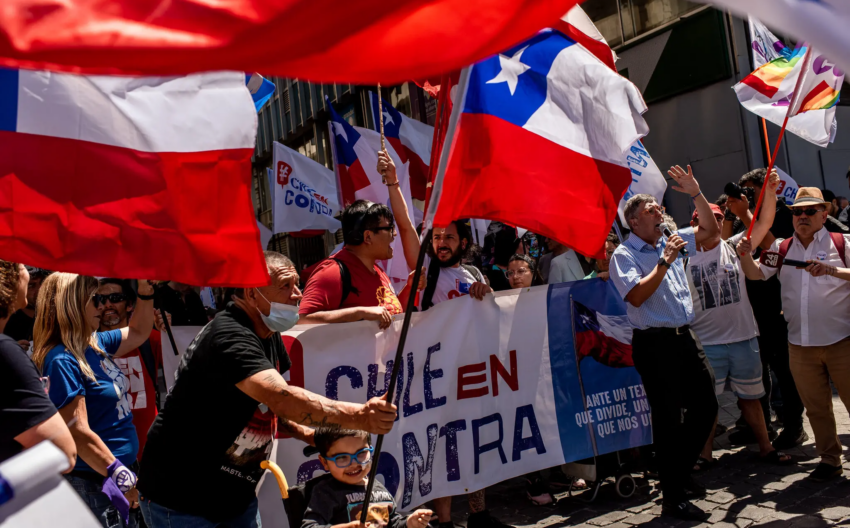
For the past four years, Chileans have been engaged in a rare democratic experiment. They have twice been asked to vote on a new constitution, and twice they have rejected the product on offer. The discussion kicked off in 2019, when violent protests over inequality roiled the country. Politicians offered citizens the chance to elect an assembly to write a new social contract. But the assembly was dominated by the hard left and alienated most voters. In a referendum last September, nearly two-thirds of Chileans voted against the charter. Once again, politicians offered citizens the chance to elect an assembly to have another go. This time, it ended up being dominated by the hard right. On December 17th, 56% of voters rejected that draft, too.
The constitutional rewrite was marked by a widespread lack of interest and rising dissatisfaction with politics. According to Roberto Izikson of Cadem, a pollster, throughout this year when respondents were asked how they felt about the constitutional rewrite, the most popular answers included “waste of time”. Since 2019 Chilean’s priorities have shifted from pensions, health care and education to crime, economic problems, and immigration. Meanwhile, the unpopular left-wing administration of Gabriel Boric has been unable to pass significant reforms while waiting for the outcome of the two constitutional processes. Many Chileans are losing patience. Only 52% say that democracy is the best form of government, compared with 64% in August 2021.
On the face of it, the rejection of the draft is a victory for Mr Boric, whose allies did not support the text. A third constitutional process is out of the question for now, allowing the administration to get on with health-care, tax and pension reforms. Yet if it is a victory for Mr Boric, it is a bitter one. The president and many of his millennial allies made a name for themselves by criticising the current constitution, which was first approved in 1980 during the military dictatorship of Augusto Pinochet but has been heavily amended since. Now they must maintain it, with little to show for the redrafting process they supported.
On Sunday night Mr Boric conceded that the process had “polarised and divided” Chileans. He called on politicians not to celebrate the result, but to double their efforts to provide answers to Chilean’s priorities.
The first convention was dominated by scandals. Many of the assembly’s 155 members were left-wing independents without party discipline. One member was kicked out after it emerged he had lied about having cancer. The charter itself was prolix and filled with overly precise, often bizarre, rights, including to “culturally appropriate” food and “digital disconnection”.
When that draft was rejected, politicians tried to avoid another fiasco. Though they greenlit the process for another assembly, they put guardrails around it. They agreed to 12 fundamental principles that had to be maintained in any new charter, including the independence of the central bank and a bicameral congress. They made it harder for independents to get a seat in the convention. Finally, they convened a commission of 24 legal experts from across the political spectrum to write a first draft. A convention of 50 members would then be elected to edit the expert’s draft.
The expert’s commission got to work in March and was a model of consensus-building. It included academics with affiliations ranging from the Communist party to the Republican party. Their draft proposal retained the current constitution’s strong protections of private property while fulfilling long-standing demands of the left, such as for a chapter on environmental rights, and rights to housing and “decent work.” Verónica Undurraga, the body’s president, says the commission was defined by “fair play and political realism”.
Such moderation did not survive the election of the assembly. Twenty-three seats on the body went to the hard-right Republican Party, led by José Antonio Kast. Another 11 were won by Chile’s traditional right. “In the last convention the majority abused its power and drafted a text beyond the pale for most Chileans,” says Loreto Cox of Pontifical Catholic University of Chile. “This time the Republicans took a text that had consensus and turned it into something much more divisive.”
Rather than merely edit the expert’s draft, the elected assembly deformed it. According to Unholster, a big data company in Santiago, only 23% of the wording from the expert’s draft was maintained. Take abortion, which is permitted in Chile only in cases of rape, threat to the mother’s life, or foetal inviability. The current constitution protects the “life of that which is to be born”. The draft text changed the wording to “the life of who is to be born”, thus potentially attaching personhood to the foetus and making it almost impossible to expand abortion rights. Conservative members also insisted on including a right to homeschooling and on limiting the ability of schools to dedicate more than half of all teaching hours to the state curriculum, seemingly in a bid to undermine sex education.
Many Chileans balked. Only 15% say they want to ban abortion completely. In a recent survey by the Centre of Public Studies, a Chilean think-tank, the share of respondents who say they prefer political leaders that seek consensus over those who defend their stance at the expense of reaching agreements, has risen from 59% in June to 70% today. The Republican Party led a polarising campaign focused on Mr Boric’s low approval rather than the contents of the constitution. One video consisted of a single chant: “Boric votes against, Chile votes in favour.” In another, a young woman says “they can all go screw themselves” in reference to the left, as pictures of burning buses flash on screen.
The assembly’s draft included numerous populist giveaways. It all but abolished a property tax that most Chilean municipalities depend on for their revenues, as well as including an article that would have allowed Chileans to deduct any “expenditures necessary for life, the care or development of the person and their family” from “corresponding taxes”. This could undermine the collection of income taxes, which are paid only by the richest quarter of Chileans and make up 7% of total tax receipts, or 1.6% of gdp. Larraín Vial, a bank, compared the move to Liz Truss’s attempt in September 2022 to drastically cut taxes in Britain. Instead of boosting growth, the bank warned, unfunded tax cuts would lead to lower revenues and higher debt and interest rates, sending Chile into a fiscal spiral “reminiscent of Argentina or Greece.”
Some ideas also appear to have been imported from the global culture wars. The draft included a right to conscientious objection, which has been used by religious business owners in the United States to decline serving customers who are lgbt. In many countries, this right is set out in law rather than in constitutions. When made the highest law, it “basically gives you the right to exempt yourself from compliance with the law on the basis of your beliefs and religion,” says Domingo Lovera, who sat on the expert’s commission.
Chile could now go in several directions. The first would be positive. In the past four years, to make the process of writing a new charter possible, politicians reduced the quorums needed to change the current constitution. That could allow congress to improve the charter with some of the suggestions from the expert’s report.
But on the other hand, the failure of the past four years to produce lasting results means that Chileans are getting increasingly fed up. “If politicians cannot reach accords in congress, then the idea that they can’t get anything done will become even more widespread,” warns Mr Izikson, the pollster. That would “open the door to authoritarian populism more than ever”.