
Israeli journalists were shown a conduit under the facility stretching over 170 meters. There’s no way the hospital’s managers didn’t know what was going onShare in TwitterShare in WhatsApp
Artículo de Yaniv Kubovich, publicado en Haaretz, el 23 de noviembre de 2023

An Israeli soldiers stands at the entrance to a tunnel under Al-Shifa hospital in Gaza, yesterday.Credit: RONEN ZVULUN/Reuters
AL-SHIFA HOSPITAL, GAZA CITY – When the first Israeli tanks crossed into the Gaza Strip late last month, Israel’s political and military leaders were already deliberating how their forces would operate in Al-Shifa Hospital. How would they expose what Israeli intelligence had pointed out over and over: Hamas’ cynical use of human shields?
It was understood that Israel’s allies would have a hard time arguing Israel’s case if the army wounded or killed patients or staff. The diagrams shown by the Israel Defense Forces’ Spokesperson’s Unit before the troops entered the compound didn’t convince people around the world that they were being shown a smoking gun.
I headed to Al-Shifa in an open all-terrain vehicle of the army’s transport unit – which left from the destroyed Kibbutz Be’eri. Only a few minutes later we were in Gaza and saw an extraordinary sight: an untouched sewage treatment plant amid rubble all around.

Israel realizes that the nearly 1 million displaced people evacuated to the south will eventually return home, and the worse the humanitarian crisis in northern Gaza, the worse the implications for Israel.
Epidemics don’t recognize the Israel-Gaza border or the new order that Israel hopes to create in Gaza, so the treatment plant was spared. Three hundred meters from there, field showers were put up for the soldiers; water tankers drove back and forth to keep the spigots supplied.
“This is Gaza’s main boardwalk; this is where they hang out,” said one of the officers commanding the convoy as it headed along the dirt road between the beach and the first row of homes.

A little imagination provided a clear look at this boardwalk before October 7. The tourist destinations had lost their signs, and most of the sites were damaged.
The high-end residential towers along the promenade had collapsed, their ruins a testament to Gaza’s socioeconomic elite who lived in luxury like anywhere else in the world – the Hamas elite. The luxury shops seem to have been looted.
On the other end of the boardwalk, in an area until recently packed with restaurants, gyms and an amusement park, nothing was left. The same went for the beach; only one lifeguard’s shed remained unharmed.
From there we turned toward Al-Shifa Hospital. For over a week the elite Shaldag unit had been operating there without firing a shot to allow Israeli and foreign journalists to tour the compound and see what had been uncovered.
On one of the main streets, before entering what had been the hospital’s emergency room, we saw what appeared to be the fruit of quality intelligence. A tunnel shaft showed how Hamas gunmen could enter a tunnel network beneath the hospital without having to enter a ward and see a patient or staff member.
In the hospital plaza, the troops laid out dozens of rifles, explosive devices, drones, hand grenades and other munitions found there. Some will be taken to Israel for study, some will be destroyed.
“This place served as a headquarters for Hamas company and battalion commanders,” IDF Spokesman Daniel Hagari said as he led journalists to a tunnel entrance located beneath one of the largest structures in the hospital. The Shaldag troops used engineering equipment to create cover positions, effectively isolating their operations from the rest of the medical center.
Some civilians came out of the hospital with their hands on their heads asking if they could move to another building. But most seem to have been used to the soldiers; they passed without fear and even said hello to the troops.
But the soldiers wouldn’t let this new routine confuse them. Any motion by a Palestinian beyond the waving of a hand was met with an immediate response. The troops told one Palestinian he had to immediately enter one of the hospital’s buildings – no one was allowed in the courtyards of this immense edifice.
“There’s no room for error here,” one of the Shaldag troops said as he stood on a mound of rubble. “The goal is to end the operation without firing a single bullet, if we don’t have to.”

Hamas siphons electricity
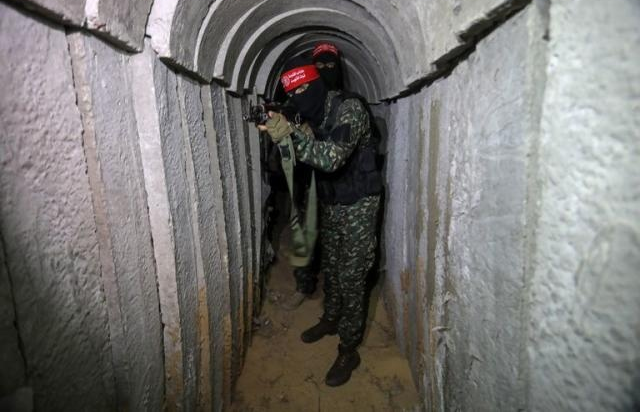
The question of whether Al-Shifa’s managers knew about the tunnels, the munitions and the military headquarters is answered the moment you go down into the tunnel with the IDF – one stretch is 170 meters long. There is no way the hospital administrators didn’t know what was happening.
This is a long tunnel network made entirely of reinforced concrete to defend against IDF attacks, replete with power sockets, power lines and ventilation equipment. Hamas siphoned power from the hospital.
The tunnels lead to well-lit, air-conditioned rooms that contain tables and beds. It’s not clear if these rooms were prepared to receive hostages, but there is no doubt they were used by Hamas company, battalion and brigade commanders, and that fighting was directed from there in recent rounds, if not in the current war as well.
Throughout the tour, we could hear the Israeli troops fighting in the nearby streets, as Israeli jets occasionally bombed the Zeitoun neighborhood. The sound of gunfire didn’t stop for a moment from that direction, but there was no firing at the hospital.
Across from the emergency room, the MRI building now houses Shaldag and combat engineering troops. Hundreds of land mines were brought there the morning I visited to destroy the tunnels under the hospital.

“The explosion here will be controlled,” one soldier said. “We don’t want to harm the surrounding structures, but it will make a lot of noise.”
The IDF believes that Hamas has other tunnels and capabilities at Shifa. It is not believed that Israeli hostages were held there.
Still, a Kibbutz Be’eri backpack and Source Sandals were found in the compound. Now the army plans to conclude its operations at the hospital, even though the forces haven’t entered many places there.
“We wanted to show the world that Hamas was using the hospital as a headquarters. This was important to us so the world would understand how cynical this organization is,” Hagari said.
He said the objective wasn’t to collect every last rifle, it was mainly to get the images out to the world. Now it remains to be seen what impact these images will have and how much time, if any, they can buy for the troops on the ground.