
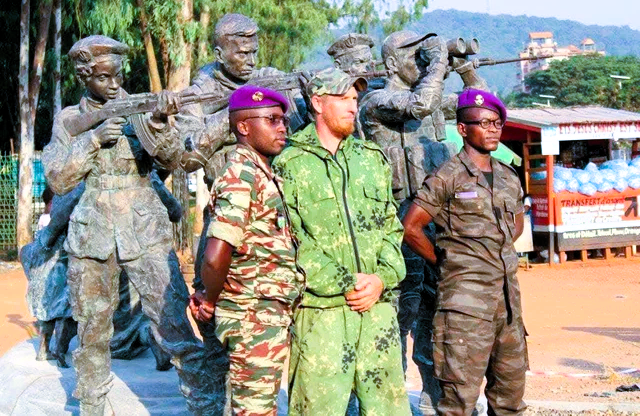
The group is unlikely to pack its bags. But African states may rethink Russia’s reliability
Publicado en The Economist, el 27 de junio de 2023
Until the events of the past week it seemed that the Wagner Group’s next outpost was more likely to be Burkina Faso than Belarus. But on June 27th Yevgeny Prigozhin arrived in the latter, as part of a deal that the country’s president, Alexander Lukashenko, said he struck between the mutinous leader of the paramilitary network and Vladimir Putin. From there Mr Prigozhin will try to run the brutal African operations that have become crucial not just to his empire but to the Kremlin’s approach to the continent.
Wagner has carried out “a huge number of tasks in the interests of the Russian Federation” in African and Arab countries, Mr Prigozhin complained in a Telegram message on June 26th. The mercenary group has sent fighters to five African states, including Mali and the Central African Republic (car), where operations by “instructors” will continue, insisted Sergey Lavrov, Russia’s foreign minister, the same day. Wagner has also had some sort of presence in at least another seven countries on the continent (as well as Syria).
What happens now is unclear. But even if Mr Prigozhin, the group’s figurehead, is sidelined it seems unlikely that Wagner will up sticks in Africa. The organisation is much more than just one man and it has a vested interest in staying put. Moreover the Kremlin will be loth to lose what has been a source of influence on the continent. Most probably, Wagner will retreat from Africa only if Africans themselves start to see Russia as a weak and unreliable partner.
To grasp what might happen next to Wagner’s African empire it helps to understand how it operates. There is no Wagner Inc but a network of firms with links to the Russian state that operate under contracts with foreign governments. Like the colonial enterprises of the 19th century, these deals allow the Russian state to partake in adventures with less accountability than if it used regular troops.

When deployed in African countries, Wagner uses a business model that has three potential elements, the mix of each depending on the country it is in. These three elements—military, economic and political—have their clearest case study in the car, the former French colony that Wagner entered in 2018. Further evidence of its role there was provided on June 27th by the Sentry, an American investigative outfit, in a new report based on dozens of interviews and analysis of government documents and other sources.
The first pillar is the military one, in cases where African clients in search of security have turned to Russia and thus, Wagner. There are no official estimates of how many Wagner fighters are in Africa but analysts suggest the number is about 5,000, with most of these in Mali and the car. (It has unknown numbers still in Syria where it augmented Russian military efforts.) The total number may be relatively small, but interviews with Wagner defectors suggest that its Africa-based fighters are skilled and battle-hardened. They also enhance the capabilities of African states’ own forces. In the car Wagner has raised a “parallel army” of roughly 5,000 fighters. Many of these are recruited from the same ethnic group as Faustin-Archange Touadéra, the president, outside the procedures monitored by the un, according to the Sentry. It alleges that Wagner has trained the fighters in torture techniques and that it commands units outside Bangui, the capital. Wagner allegedly imported weapons, drones and aircraft in violation of a un arms embargo.
Wagner used this parallel army as part of a “campaign of terror”, says the Sentry. It accuses Wagner of massacres, torture and rape as part of the group’s strategy of “cleansing” villages. It quotes one car soldier under Wagner command as saying: “We kill villagers only, we bury them, or we throw them in the bush.” (Spokespeople for Mr Touadéra and the Wagner Group did not respond to requests for comment.)
Though The Economist could not independently verify the Sentry’s claims, they chimed with other investigations, including by Human Rights Watch. The un estimates that one in five people in the car is internally displaced or a refugee. An astonishing study published in April in Conflict and Health, a journal, suggests that 5.6% of the car’s population died last year, more than four times the un’s estimate for the car in 2010 and more than twice the share reported by any other country. Wagner’s presence “at least contributed to increased difficulties of survival”, say the researchers, diplomatically.
The second element of Wagner’s business model is economic—the quid for a security quo. Wagner should not be thought of as a hierarchical business, but instead as a loose conglomerate with a network of subsidiaries. In January America added Wagner to its list of “transnational criminal organisations” that face sanctions. There is little transparency into its revenues or profitability, but what seems clear is that Africa is a crucial part of its money-making. In February, for instance, the eu imposed sanctions on a Wagner-linked firm for its role in the gold trade in Sudan.
In the car various nodes of Wagner’s business network connect. Wagner, says the Sentry, has killed and looted villages near gold- and diamond-mining areas. Mining equipment from Russia is allegedly imported via Cameroon by a company registered in Madagascar. The Sentry counted 15 flights by Wagner-linked planes to Sudan, a gold-trafficking hub. It used satellite imagery to show the growth of Ndassima, a gold mine that was once the preserve of “artisanal” miners but is now allegedly run by a Wanger-linked firm. Wagner is also keen for it and the car’s government to exert greater control over production by small-scale miners, alleges the Sentry.
The car is also a case study of the political services Wagner offers—the third element of its model. The Sentry notes that the group ran pro-Touadera campaigns in the run up to elections he won in 2020 and helped negotiate political deals with leaders of various factions. Elsewhere in Africa, Wagner companies have run propaganda and disinformation campaigns, and organised sham election-observation groups.
Understanding the Wagner model is useful in thinking through what may happen next. There is some speculation that as part of any deal between Mr Prigozhin and Mr Putin, the former may be able to maintain his role in Africa, though it is unclear if any such deal will be honoured. (On June 27th Russia’s president seemed to emphasise who controlled whom when he admitted that the state had directly funded Wagner’s operations, at least in Ukraine.) Some think that the profits Wagner earned in Africa may have provided an incentive for Mr Prigozhin to stage his uprising in Russia. “Wagner demanded more money and material to continue his actions in Africa,” a French diplomatic source familiar with the activities of the group told Le Monde, a newspaper. “That’s where it all started.”
Given its structure, “whatever happens to Prigozhin says very little about what happens to the Wagner Group in Africa,” argues Kimberly Marten of Columbia University’s Barnard College. He is neither the ceo of a unified Wagner firm nor a top-down commander. Though he may be a charismatic leader and adept at logistics, it would be “relatively easy” for Russia’s defence establishment to replace him, she argues.
The people and entities in the Wagner network also have their own interests that they will wish to maintain. Some of these are linked to Mr Prigozhin; some much less so. The “bottom up” evolution of the group is often missed, argues John Lechner, the author of a forthcoming book on Wagner. “And even if there were a big shift at the top of management then you’re not going to fire everyone else.”
Wagner has also been a critical part of the Kremlin’s resurgent interest in Africa over the past decade. After the annexation of Crimea in 2014, and again last year, Russia redoubled its engagement on the continent. Next month Mr Putin will host African leaders at a summit in St Petersburg. Wagner is far from the only tool in its African toolkit, but it has been a low-cost high-impact instrument. “The advantages that Wagner offers the Russian state will still remain,” argues Julia Stanyard of the Global Initiative against Transnational Organised Crime, who co-authored a report into the group, published in February, that described Wagner’s “tripartite” business model.
The advantages Wagner offers Russia are multiple. It is a source of gold, stockpiles of which help Russia resist the impact of Western financial sanctions. It also helps seed anti-Western messages across fertile ground in the African countries in which it operates. (Wagner was reportedly behind the lie that French soldiers were responsible for the killing of nine Chinese nationals at a mine in the car earlier this year.) It establishes unofficial channels of influence with African politicians that can be turned into official relationships. In the car, for instance, the country’s ambassador to Russia recently suggested that things had gone so swimmingly with Wagner that his government would consider hosting a Russian military base.
Even so, the Russian security services may wish to alter the structure of its arrangements with Wagner. One option would be to nationalise the group, though that may suit neither the Russian state, which can currently claim to deny responsibility for Wagner’s atrocities, nor African governments, who can more plausibly argue they remain in control of their security if they use mercenaries rather than foreign troops. Other options might be to rebrand the group, bring in new leadership or shift the constituent firms so that different elites are in control. Regardless, it would seem illogical for Russia to unilaterally withdraw from fruitful ventures. “It would damage Russia in the eyes of African governments if they pulled them out,” adds Ms Stanyard.
It may be that the most important factor in deciding Wagner’s future on the continent will be its African customers—the politicians who have turned to Russia for help. In the car, where Wagner’s influence is most entrenched, the government seems unmoved. Fidèle Gouandjika, an adviser to Mr Touadéra, told the afp news agency that “the car signed a defence agreement in 2018 with the Russian Federation and not with Wagner”, adding that “Russia has sub-contracted with Wagner, if Russia no longer agrees with Wagner then it will send us a new contingent”. Any tensions between Mr Prigozhin and Mr Putin are “an internal matter in Russia”.
In Mali, meanwhile, a recent gamble by the ruling junta looks even riskier. On June 16th the military-led government told a 13,000 strong un peacekeeping mission to leave “without delay”. Last August, nine months or so after Wagner arrived, French troops left after a nine-year deployment. The junta hoped that Russia would protect it from repercussions at the un and that Wagner would help it fight the jihadists who have killed thousands over the past several years. Yet as the mutiny unfolded Sadio Camara, the junta’s minister of defence, was “almost feverish” with anxiety, reported Jeune Afrique, a magazine based in Paris.
Since the mutiny, African elites may well be changing their opinion of Russia. Jędrzej Czerep of the Polish Institute of International Affairs notes that some of Africa’s most influential cheerleaders for Russia have gone quiet in recent days. This reflects how support for Russia depends on it being seen as powerful enough to help its African clients achieve their own ends. “It will lose its charm as soon as it looks weak and incapable,” he argues. A long-anticipated deployment of Wagner forces to Burkina Faso, which like Mali is run by a military junta, is now surely less likely.
That points to an irony that will not be lost on many African observers. Russia’s president pitches his country not only as a strong ally for African leaders but something of a model. Yet the very same group that his government has sent to help African leaders fight internal enemies has itself staged an uprising in Russia. That is hardly an advertisement for a regime selling coup protection to autocrats and juntas abroad.