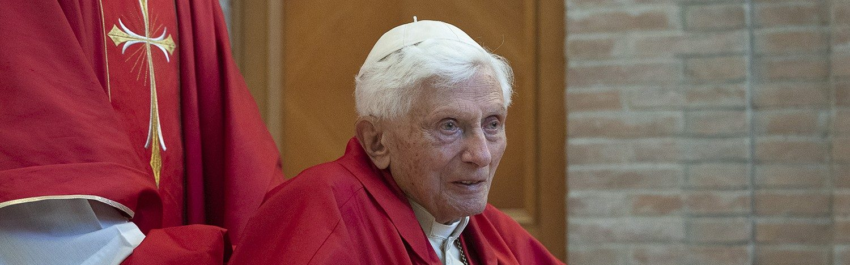
The first pope to resign voluntarily died on December 31st, aged 95
Artículo publicado en The Economist, el 31 de diciembre de 2022
Pattering in the forceful, tumultuous wake of John Paul II, Benedict XVI had a hard act to follow. In 2005 there were few expectations. Or rather, there were expectations of the wrong kind: that the man who from 1981 had been prefect of the Congregation for the Doctrine of the Faith (cdf) would rule the Roman Catholic church like an elderly headmaster, waspish and intolerant, with the fires of a new Inquisition gleaming in those pale blue eyes.
Where John Paul’s Polishness was refreshing, Joseph Ratzinger’s Germanness worried people. As a boy in deeply Catholic Bavaria he had been conscripted into the Hitlerjugend and briefly trained for the disintegrating Wehrmacht; after that his life had been the seminary, the professoriat, the faculty of theology at Regensburg, the College of Cardinals. He was surely so academic that he would not warm to the pastoral, crowd-pleasing side of the pontificate; he was surely so schooled in youth to heel-clicking obedience that any stirrings of liberalism in the church would be crushed beneath his elegant fist.
But just as his predecessor had possessed a shell of cold steel behind the warm sociability, “Rottweiler” Benedikt showed himself in the most sacred office from a surprisingly gentle, even shy side. He was crazy about cats, petting the strays of Rome and talking to them in German. He loved to play Mozart on the piano, and on warm summer evenings in the papal residence of Castel Gandolfo, he would serenade the locals from the open windows. His Bavarian roots survived in a fondness for potato dumplings and bratwurst. Fashion-conscious to the point of tight-fisted, he ordered gold-woven robes in the style last worn by Paul V, the Borghese Pope, and liked to wear red Gucci loafers under his all-white robes.
The papal world tour now required wearyed this man who had prayed to hide in the Vatican Library before the white cloak fell on him; and his radical, lonely decision to retire in February 2013, the first by a pope in 600 years, proved how hard he found the job. But there was a certain simple sweetness to his manner that made young people like him and made Queen Elizabeth, the head of the Church of England, almost at ease with the papacy when he stayed with her at Holyroodhouse in 2010. He taught that the essence of Christianity was pure joy, the joy that God’s love is infallible, like the song of the lark he heard singing from the altar at the moment of his ordination in June 1951. His first encyclical Deus Caritas EstIt was all about that love for her Eros and agape of man for God and God for man; and he once remarked to journalists that maybe, like angels, people could fly a bit if they didn’t take themselves too seriously.
He found apologies harder. However, the world seemed to expect it from him: an apology to the Jews for the Vatican’s apparent indifference to the Holocaust, and another to the thousands of victims of pedophile priests in Europe and North America. He apologized in his own way, in institutional terms. A general prayer for peace in the Middle East was pushed between the blocks of the Western Wall in Jerusalem. In Malta, for abused children, he cried the sincere tears of an old man who felt that the activities of misguided priests had left “a stain” and “dirt” on the Church. But in his prime at the cdfwhere he had vigorously persuaded John Paul II to have such cases dealt with, he had written letters recommending that offenders be transferred to other parishes and had kept silent about any internal inquiries.
His inquiring intelligence, which shone through in his encyclicals, sometimes got him into trouble. In a lecture in Regensburg in 2006, in which he called for a dialogue between faith and reason, he remarked that Muhammad brought only “evil and inhuman” into the world; the press chose not to notice that this was a quote from 14th-century Byzantium. Bent over in his study, he often seemed willfully without media advisors, only in touch with stern, pure, complex minds like his own.
These minds were conservative. He had followed the reformers within the church for a while and knew Hans Kiing, the most famous liberal theologian, in Tubingen; but the turmoil of the 1960s traumatized him. His post at the cdf asked him to crush heresy and affirm doctrine, and he did. A whirlwind of excitement erupted in 2010 when, during a six-hour interview with Peter Seewald, a German journalist, he revealed that condom use was banned AIDS is “a step on the way to a different, more humane sexuality”. It was a single point in an unwavering message that condoms made AIDS worse. This was the Pope, after all, who two years earlier had issued a letter allowing a more general use of the old Tridentine rite (along with anti-Semitism) in which the priests turned their backs on the community and the faithful knew their place. Catholics would have been wrong, he wrote, in assuming that the Second Vatican Council of 1962-65 authorized creativity, be it in the liturgy or anything else.
Just up the hill
During the pontificate of his passionately reformist successor, Francis, he remained largely invisible in the monastery where he lived, high on the hill. He seemed happily adjusted to his unprecedented emeritus role, although he would have preferred to be simply “Father Benedict”; he liked Francis’ company and never openly contradicted him, telling rare interviewers that they were in complete agreement on everything. The same was not true of the courtiers around him, a “Regensburg network” of conservatives and traditionalists who were in close contact with right-wing American media and who viewed him as a touchstone of their intrigues and defiance. They saw in Benedict and his earlier utterances a means of saving the Church from novelty and heresy.
He was then far too old and frail for such a role, even if he had wanted to. He almost certainly didn’t. But there was no doubt that this was a man for whom relativism was the greatest evil in the modern world, and doctrinal integrity the surest defense against it. And that shouldn’t surprise anyone.