REALPOLITIK LESSON WITH ARANCHA GONZÁLEZ LAYA
Artículo publicado en POLITICO – BRUSSELS PLAYBOOK, el 3 de junio de 2022
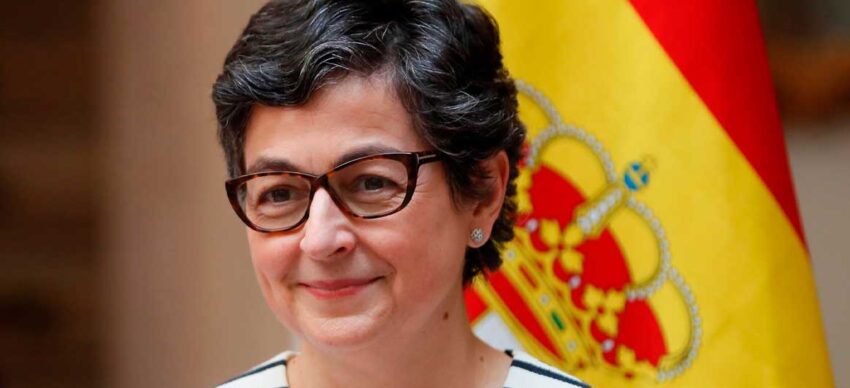
She is one of Spain’s most renowned and internationally respected civil servants, who climbed to the top of the ladder as an expert in the European Commission and international institutions, rather than as a political soldier within a party. But the former Spanish foreign minister last year had to resign over a major diplomatic crisis with Morocco, before becoming the dean of the Paris International Relations School of Sciences Po.
Power politics vs. rule of law: While she does not want to criticize the government she worked for, González Laya is clear when asked about PM Pedro Sánchez’s historic and much-criticized decision to recognize Morocco’s illegal annexation of Western Sahara (a Spanish colony until 1975) — a decision that infuriated Algeria, one of the EU’s biggest gas suppliers.
By the book: “What I will say is … I think it’s important to abide by international law, because that’s the best antidote against power-based politics,” González Laya told Playbook. Asked if this includes the U.N. decision according to which Western Sahara has the right to be independent of Morocco, she said: “The U.N. is the embodiment of international law, and a rules-based international order.”
Repercussions for the EU: Spain’s about-turn on Morocco caused Algeria to cut its natural gas shipments to Spain last month, arguably at the worst possible moment for the EU, which was already struggling with record-high energy prices. “I think we have to go back to fundamentals,” González Laya said. “Spain — and Europe — need a good relationship with the entire Mediterranean neighborhood, not just Morocco, but also Algeria, Libya, Egypt.”
Meritocrat in Downton Abbey: Like France’s new foreign minister, whose diplomats are striking against a reform of the foreign ministry, González Laya encountered strong opposition as she tried to reform Spain’s archaic diplomatic service, which is still seen as a job-provider for the country’s noblemen. “The ministry needed to be modernized, not against its will, but together with its staff,” she said. “I moved the needle from 12 percent of ambassadors being women to 21 percent — so in the space of a year and a half, we had given a signal.”
Glass ceiling: Alas, “I could not take forward a number of the recommendations” made by an expert commission, which included reforming the selection process, González Laya admitted. Indeed, the core of the reform was scrapped after she stepped down, and has not been taken forward by the new foreign minister, José Manuel Albares.
No conspiracy: However, González Laya denied her departure was propelled by these attempted reforms, arguing that the idea of a cabal of noblemen scheming to get rid of her was the stuff of “legends.”
Burn after reading: González Laya found herself at the center of a storm after Rabat discovered Madrid had flown the leader of the Western Saharan independence movement, Brahim Ghali, to be treated in a Spanish hospital for COVID. Madrid announced last month that González Laya’s phone had been tapped during that episode.
Hacked off: “The thing that worries me the most is that everything was done to [discredit] and throw mud at a humanitarian decision taken by the government … to help a citizen who happens to be a Spanish citizen,” González Laya said. Asked if that meant she didn’t take the decision to fly in Ghali alone, she said: “Humanitarian decisions are governmental decisions, not personal decisions. Obviously, I was heading foreign policy. But what I did was the expression of a government policy.”
Does she consider herself a sacrificial lamb for Morocco? “No,” González Laya said. “Look, you don’t question these decisions … you serve at the mercy and at the pleasure of your prime minister … So, when you enter political life, you’ve got to be extremely clear.”
LEGACY: González Laya brightened up when she spoke about her negotiations with France, Germany and Italy on the historical NextGenEU budget — with massive joint EU borrowing for the first time in the bloc’s history.
Paper giants: González Laya pointed out that it was Madrid which kickstarted the debate on joint EU borrowing, with a well-timed non-paper that channeled the anti-austerity momentum, while avoiding pitfalls such as mentioning the toxic (for Germanic ears) word “eurobonds.”
The document was “the beginning of the Next Generation EU. It started there, with this non-paper. We were very modest, didn’t know if it was going to float … But the essence of it was then taken in the Franco-German proposal, which was then reflected in the proposal that [European Commission President] Ursula von der Leyen put on the table.”
How to do it: González Laya said the paper was a joint effort by the PM’s office, Economy Minister Nadia Calviño and herself. The trick was seeing that “we had an opportunity to build a more solid Europe. But doing this while also navigating the very extreme views that were represented by Italy on the one hand, and Germany, on the other hand.”
Are we back to where we started, considering Germany’s “no” to a second round of EU borrowing? “I’ve learned in this business that you don’t say categorical noes or yeses, because you may just come to regret having said that. I don’t think that the German finance minister was foreseeing that there would be a war in Ukraine, and that war in Ukraine would have the impact that it’s having on spending.”
Danone and Russia: On top of her university job, González Laya is also advising French dairy giant Danone, which still hasn’t pulled out of Russia. What’s her view on that? “Danone has frozen every new investment in Russia,” González Laya said, arguing that “what it has kept is first line of support with basic food, basically out of our humanitarian responsibility with everyday citizens of Russia … they do baby food, for example.”
So no Activia and strawberry yoghurt for middle-class Russians? “They do what’s essential in their humanitarian responsibility with the citizens,” González Laya insisted.